

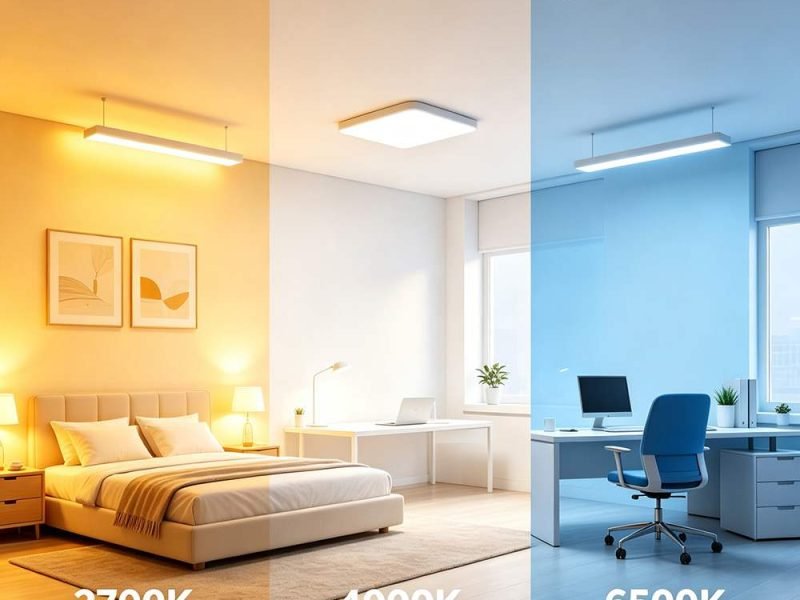
When shopping for an LED light, you may have noticed numbers such as 2700K, 3000K, 4000K, 5000K, or 6500K printed on the product package.
At first glance, these numbers can be confusing. Is 5000K brighter than 3000K? Does a higher Kelvin rating mean the LED light uses more electricity? Is 2700K better for a bedroom while 4000K is better for a kitchen?
These numbers are part of the Kelvin light scale, one of the most important specifications used to describe the appearance of white light.
The Kelvin scale tells you whether an LED light will look warm and yellowish, neutral and balanced, or cool and bluish. Lower Kelvin values produce warmer-looking light, while higher values produce cooler-looking light.
Understanding this simple scale can make choosing LED lighting much easier.
What Is the Kelvin Light Scale?
The Kelvin light scale is a way of describing the color appearance of light using the unit Kelvin (K).
In lighting, the term is commonly associated with color temperature or, more precisely for many modern LED products, correlated color temperature (CCT).
The basic rule is surprisingly simple:
Lower Kelvin = warmer light
Higher Kelvin = cooler light
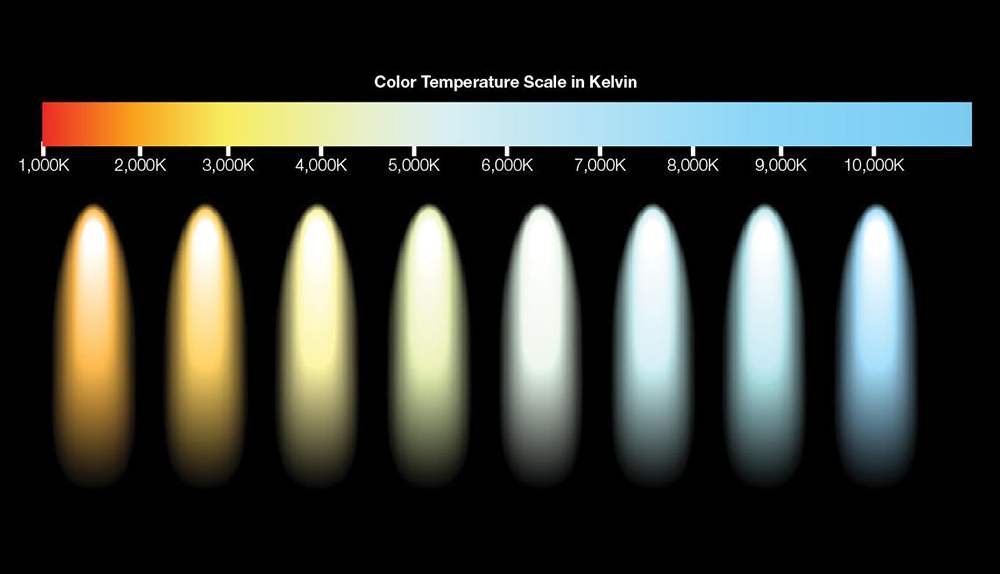
For example, a 2700K LED light generally has a warm, yellowish appearance similar to traditional incandescent lighting. Move up to 4000K and the light becomes much more neutral and white. At 5000K, the light has a noticeably cooler, daylight-like appearance.
Wired4Signs USA describes the Kelvin light scale as ranging from warm yellow and reddish tones at the lower end toward increasingly white and blue tones as the Kelvin value increases.
This is why the Kelvin number on an LED package is useful: it gives you an indication of what the light will look like, rather than simply telling you how much light the product produces.
Why Is It Called “Color Temperature”?
The term can sound strange.
After all, when you see “5000K” on an LED bulb, it doesn’t mean the bulb itself is physically operating at a temperature of 5000 Kelvin.
The concept comes from the appearance of light produced by an idealized heated object, often described using a black-body radiator. As the temperature of that theoretical object increases, the color of the emitted light changes from reddish to yellowish, then white, and eventually bluish.
The Kelvin scale provides a standardized way of describing those color appearances.
Modern LED lights don’t necessarily work by heating a piece of metal to the specified Kelvin temperature. The Kelvin rating is instead used to describe the visual color of the light.
So if an LED package says 3000K, don’t worry—the lamp isn’t secretly trying to turn your kitchen into a 3000K furnace.
It’s simply telling you about the color of the white light.
Does a Higher Kelvin LED Light Mean It Is Brighter?
No.
This is one of the most common misunderstandings about the Kelvin light scale.
Kelvin measures color temperature, while brightness is normally expressed in lumens.
For example, you could have:
- 3000K LED light — 800 lumens
- 4000K LED light — 800 lumens
- 5000K LED light — 800 lumens
All three can produce the same amount of measured light output while looking completely different.
A 5000K light may appear brighter or more energetic because the cooler white color provides a different visual impression, but that doesn’t mean it necessarily produces more lumens.
If you’re comparing LED products, keep these specifications separate:
Kelvin (K) = light color
Lumens (lm) = light output
Watts (W) = electrical power consumption
CRI = how accurately colors are rendered
This distinction becomes particularly important when choosing LED lighting for kitchens, offices, bedrooms, and workspaces.
1800K–2200K: Very Warm and Cozy Light
At the lower end of the Kelvin light scale, around 1800K–2200K, the light becomes strongly warm, amber, or candle-like.
Think about the atmosphere of a candle, fireplace, or very warm decorative lamp.
This type of LED light is usually not chosen as the primary source for detailed tasks. Instead, it is useful when atmosphere matters more than maximum visual clarity.
It can work well in:
- Restaurants
- Bars
- Hospitality spaces
- Decorative lighting
- Bedrooms
- Accent lighting
- Relaxation areas
If you want your lighting to say “sit down, relax, and forget about your emails,” this is the end of the Kelvin scale you want to explore.
2700K: Classic Warm White
2700K is one of the most familiar warm-white lighting temperatures.
It produces a soft, yellowish-white appearance that is relatively close to the traditional appearance of incandescent bulbs.
This makes 2700K particularly popular for residential spaces where comfort and atmosphere are important.
Common applications include:
- Bedrooms
- Living rooms
- Dining rooms
- Bedside lamps
- Decorative wall lights
- Hospitality interiors
Wired4Signs USA places 2700K within the warm-white range and notes that it works particularly well in living rooms and bedrooms, as well as with natural wood and traditional interior finishes.
For an LED table lamp, 2700K can create a comfortable evening atmosphere. For an LED wall light installed in a bedroom or living room, the same color temperature can provide a soft decorative effect.
3000K: Warm, but a Little Cleaner
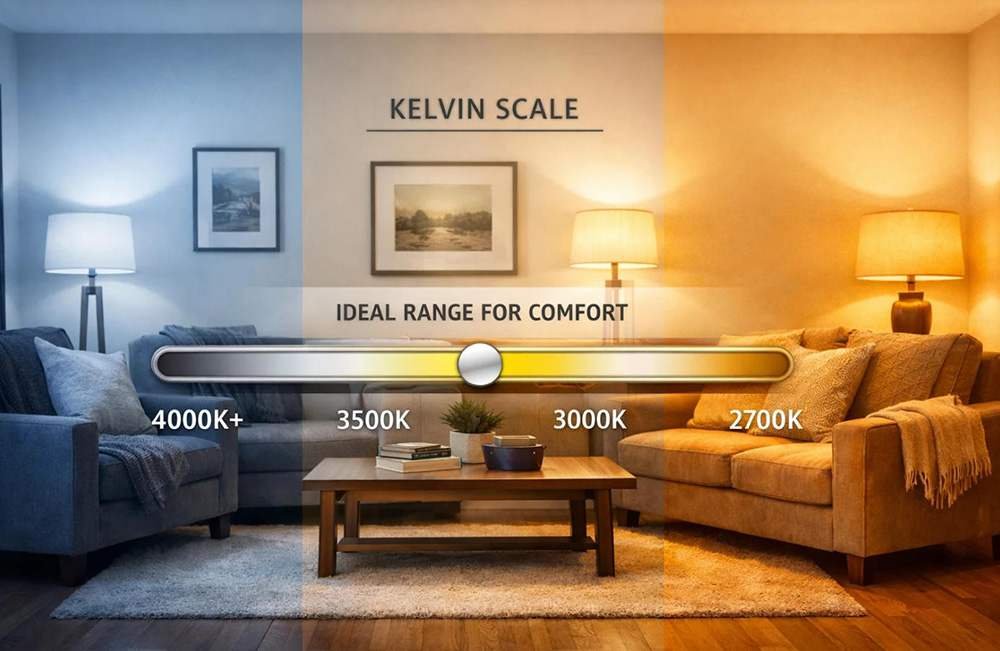
If 2700K feels too yellow for you, 3000K is often a useful middle ground.
The light remains warm, but it usually appears cleaner and less amber than 2700K.
This is one reason 3000K is popular in modern residential lighting.
It can work well for:
- Kitchens
- Living rooms
- Hallways
- Bathrooms
- Dining areas
- LED wall lights
- Under cabinet lighting
- Hotels and restaurants
For residential interiors, 3000K often provides a useful compromise between atmosphere and visibility.
For example, an under cabinet LED light at 2700K can create a very warm kitchen atmosphere, while 3000K can provide a little more visual clarity without making the kitchen feel overly cool.
3500K–4000K: Neutral White
Move further up the Kelvin light scale and you reach 3500K–4000K, where the light becomes much more neutral.
This range is popular in spaces where people want a clean appearance without the strong blue-white character associated with higher color temperatures.
4000K is particularly common in:
- Kitchens
- Bathrooms
- Home offices
- Offices
- Retail spaces
- Workshops
- Schools
- Commercial interiors
Wired4Signs USA recommends the 3500K–4000K range for spaces such as kitchens, bathrooms, and offices because it provides a balance between warmth and visual clarity.
For task-oriented LED lighting, 4000K is often a practical choice.
It is also worth noting that the exact appearance of 4000K can vary between manufacturers. Two products with the same nominal CCT can still look slightly different depending on their LED technology, optical system, phosphor characteristics, and color consistency.
5000K: Daylight White
At around 5000K, LED light becomes distinctly cooler and more similar to daylight.
It generally has a crisp white appearance and can be useful when visual clarity is a priority.
Typical applications include:
- Workshops
- Garages
- Work areas
- Utility rooms
- Detailed task lighting
- Photography
- Some commercial spaces
Wired4Signs USA describes 4500K–5000K as a daylight-oriented range suitable for task-focused environments.
However, 5000K isn’t automatically “better” than 3000K or 4000K.
Imagine installing 5000K lighting throughout a cozy bedroom. You may get plenty of visibility—but the room could feel more like a workshop than a place where you want to relax.
Lighting is not just about seeing things. It is also about creating the appropriate visual environment.
5500K–6500K: Cool, Daylight-Like Light
At 5500K and above, the light becomes increasingly cool and can take on a subtle blue appearance.
Around 5600K is widely used as a daylight reference in photography and film, while higher values such as 6000K–6500K produce an even cooler appearance.
These temperatures can be useful for:
- Photography
- Industrial environments
- Workshops
- Garages
- Specialized task lighting
- Certain commercial applications
They are less commonly chosen for cozy residential environments.
That doesn’t make them bad. They simply create a very different visual atmosphere.
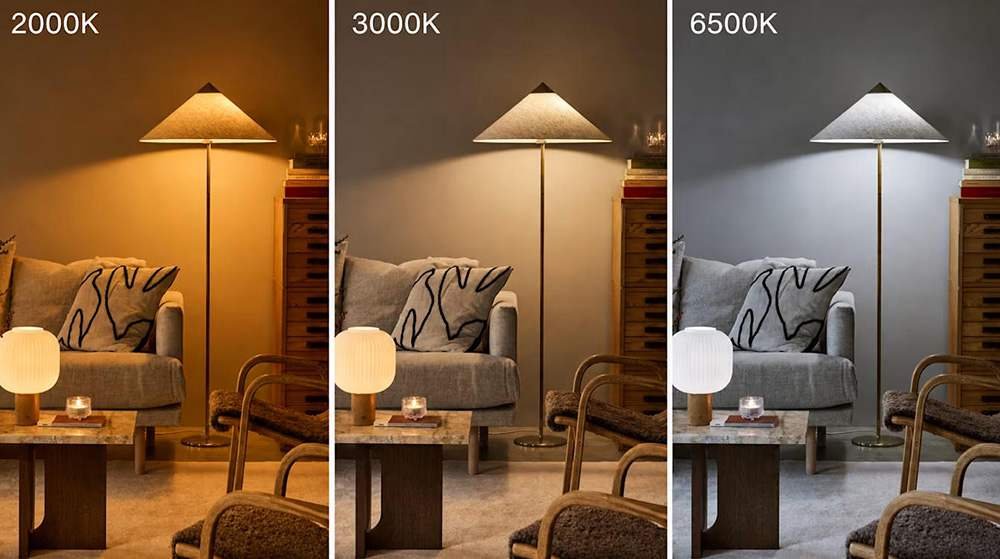
Kelvin Light Scale Comparison
Here’s a quick way to visualize the most common LED lighting color temperatures:
Kelvin | Appearance | Typical Applications |
1800K–2200K | Amber / candle-like | Decorative, hospitality, accent lighting |
2700K | Warm white | Bedroom, living room, dining room |
3000K | Soft warm white | Home, kitchen, bathroom, wall lighting |
3500K | Warm-neutral | Residential and commercial interiors |
4000K | Neutral white | Kitchen, office, bathroom, workspace |
5000K | Daylight white | Garage, workshop, task lighting |
5500K–6500K | Cool daylight | Photography, industrial, specialized applications |
These ranges are useful guidelines rather than strict rules. Interior finishes, natural daylight, fixture design, CRI, personal preference, and the intended task can all influence how a particular LED light looks.
Which Kelvin Is Best for a Kitchen?
Kitchens are interesting because they often have two completely different jobs.
At 7 p.m., you may want your kitchen to feel warm and comfortable.
At 7 a.m., you may want enough clarity to actually see what you’re chopping.
This is why 3000K–4000K is often a practical range for kitchen LED lighting.
If your kitchen has lots of wood, warm-colored cabinets, and a traditional design, 3000K can work particularly well.
If you have a modern kitchen with white cabinets, gray surfaces, and a clean contemporary style, 3500K–4000K may provide a more neutral appearance.
For under cabinet lighting, the choice is especially noticeable because the light is close to countertops, backsplashes, and food-preparation areas.
A tunable-white LED system can be an interesting alternative because it allows users to change the color temperature depending on the time or activity. Wired4Signs USA also highlights tunable-white LED strips as a way to move between warmer and cooler lighting as needed.
Which Kelvin Is Best for a Bedroom?
For bedrooms, warmer LED light is usually the more natural choice.
2700K–3000K works well for bedside lamps, wall lights, reading lights, and general evening illumination.
The reason is simple: warm light tends to create a softer and more relaxing visual environment.
That doesn’t mean you can never use 4000K in a bedroom. If you have a dedicated reading or working area, a more neutral task light can make sense.
A good lighting design can therefore use different Kelvin temperatures for different purposes rather than forcing the entire room to use one color.
Which Kelvin Is Best for a Home Office?
For a home office, 3500K–4000K is often a good starting point.
It provides a relatively neutral appearance that works well for reading, computer work, writing, and other tasks.
If you frequently perform detailed work, you may prefer a cooler temperature. However, going straight to 6500K simply because it sounds “professional” isn’t necessarily the answer.
The ideal temperature depends on the room, natural daylight, screen environment, task, and personal preference.
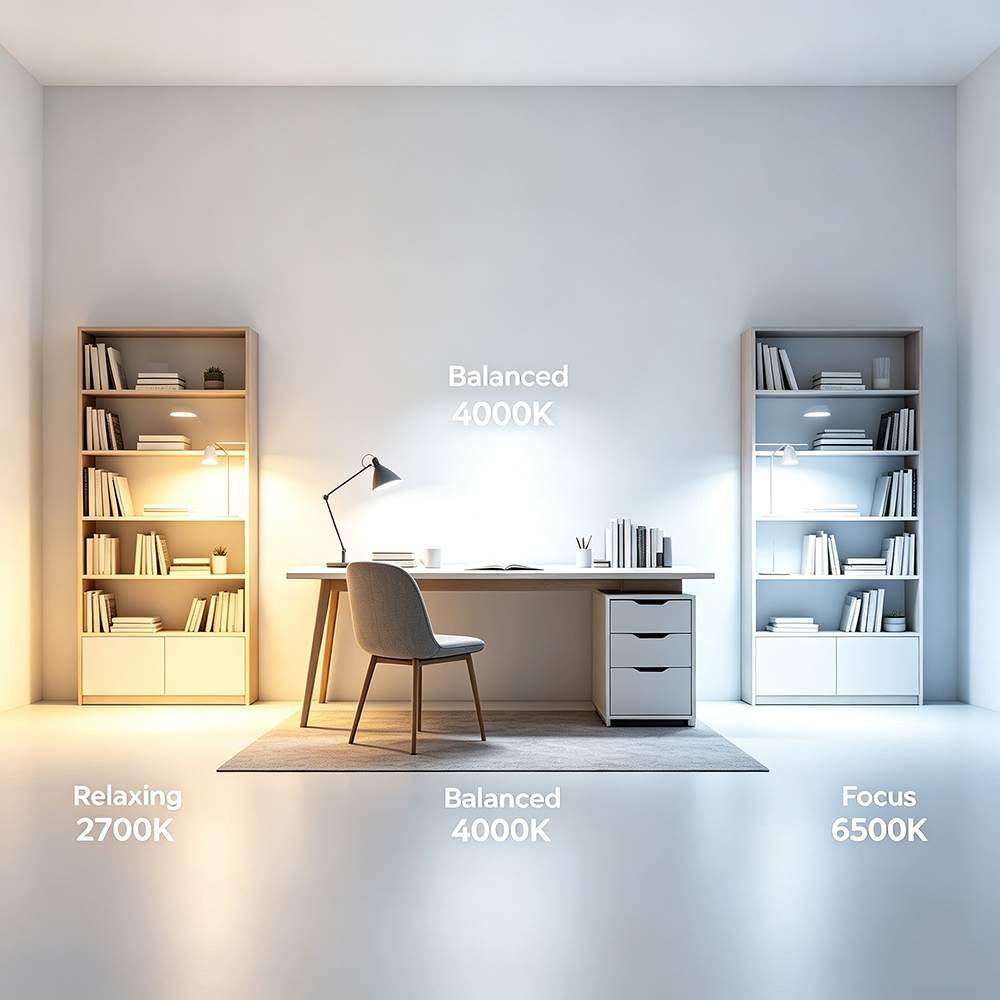
Kelvin vs. Lumens: Don't Mix Them Up
Imagine you’re comparing two LED table lamps.
Lamp A:
3000K / 1000 lumens
Lamp B:
5000K / 500 lumens
Lamp A can actually produce twice the measured light output of Lamp B, despite having a warmer color.
This is why looking only at the Kelvin number when buying LED lighting can lead to mistakes.
If you want to know how much light a product produces, look at lumens.
If you want to know what color the light looks like, look at Kelvin.
If you want to know how accurately the light reveals colors, look at CRI.
These three specifications answer three different questions.
Can You Change the Kelvin of an LED Light?
Yes—if the LED product supports tunable white or CCT adjustment.
Instead of producing only one fixed color temperature, tunable LED lighting can allow users to move between warmer and cooler white light.
For example, a kitchen could use warmer light during dinner and a cooler setting during food preparation.
A home office could use a neutral setting during work hours and shift toward a warmer tone later in the evening.
This type of flexibility is becoming increasingly useful in smart LED lighting because color temperature can be controlled through switches, remotes, sensors, apps, or smart-home systems.
What Should You Consider Besides Kelvin?
Kelvin is important, but it isn’t the whole lighting story.
A 3000K LED light can still be uncomfortable if it has excessive glare.
A 4000K LED light can look excellent if it has good diffusion and high color rendering.
Likewise, a 5000K product isn’t automatically better for detailed work if its beam is poorly controlled.
When choosing LED lighting, consider:
Kelvin: What color does the light look like?
Lumens: How much light does it produce?
CRI: How accurately does it reproduce colors?
Beam angle: Where does the light go?
Glare: Is the light comfortable to look at?
Dimming: Can the brightness be adjusted?
Flicker: Is the light output stable?
Looking at all of these factors gives you a much better understanding of the actual lighting quality than Kelvin alone.
Final Thoughts: Kelvin Is About the Feeling and Appearance of Light
The Kelvin light scale may look like a technical specification printed on an LED package, but it has a surprisingly large effect on how a space looks and feels.
At the warm end, 2700K–3000K creates a softer and more comfortable atmosphere.
Around 3500K–4000K, LED light becomes more neutral and versatile, making it suitable for kitchens, bathrooms, offices, and many everyday spaces.
At 5000K and above, the light becomes increasingly daylight-like and is often better suited to task-oriented or specialized environments.
The important thing is that there is no universally “best” Kelvin temperature.
A bedroom does not need the same light as a garage. A restaurant does not need the same light as a workshop. And the LED light above your kitchen countertop does not have to look the same as the LED table lamp beside your bed.
Once you understand the Kelvin light scale, those mysterious numbers on LED lighting packages become much easier to interpret.
Instead of asking, “Is 5000K better than 3000K?”
You can ask the much more useful question:
“What kind of light do I actually need for this space and this activity?”
And that is where choosing the right LED light starts to become much easier.