

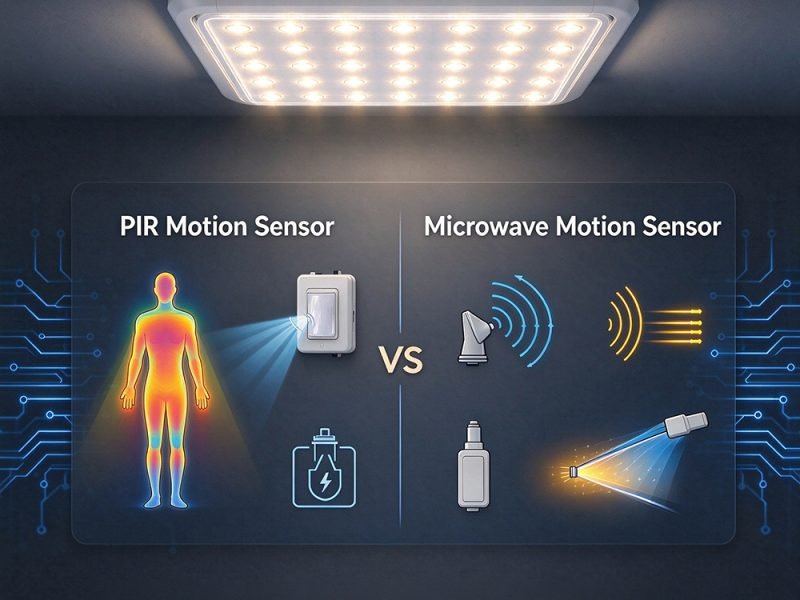
Motion sensors have become an important feature in modern LED lighting systems. They help reduce unnecessary energy consumption, improve convenience, and provide automatic illumination in areas where lights do not need to remain on continuously. However, not all motion sensors work in the same way.
Two of the most common technologies used in motion-activated lighting are PIR motion sensors and microwave motion sensors. Both can automatically switch LED lights on when movement is detected, but they differ in how they detect motion, how they respond to their surroundings, and where they perform best.
Understanding these differences is important when choosing PIR motion sensor LED lighting for homes, commercial buildings, warehouses, corridors, and outdoor applications.
What Is a PIR Motion Sensor?
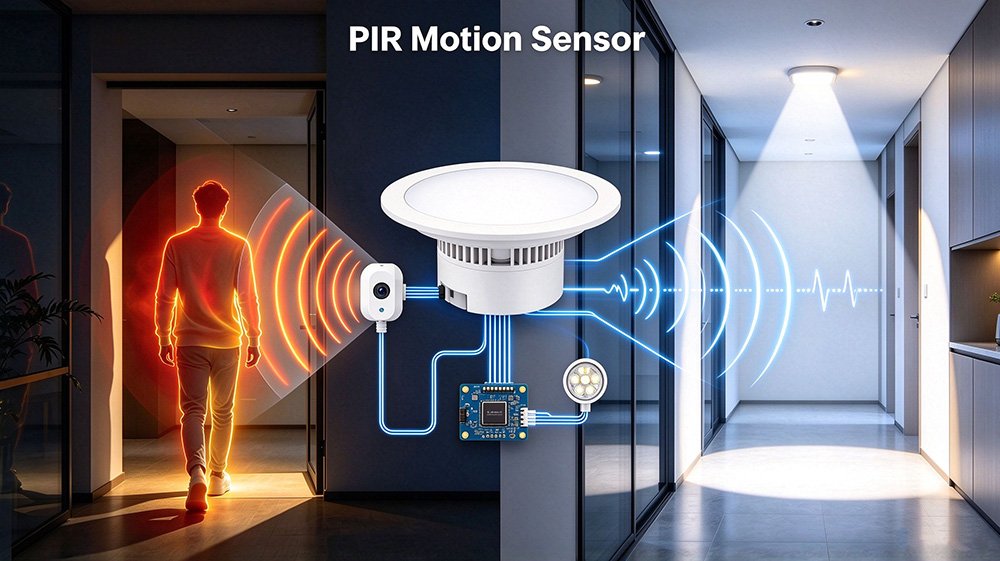
PIR stands for Passive Infrared. A PIR motion sensor detects changes in infrared radiation, which is emitted by people, animals, and other objects according to their temperature.
The sensor does not transmit a detection signal. Instead, it monitors changes in infrared energy within its field of view. When a person moves across the detection zones, the changing infrared pattern can trigger the sensor and activate the connected LED light.
PIR sensors commonly use a pyroelectric sensing element and a segmented Fresnel lens to help detect changes in infrared radiation across different areas.
How Does a PIR Sensor Work in LED Lighting?
A typical PIR-controlled LED lighting system works through three basic steps:
1. Monitoring:The sensor continuously monitors infrared radiation within its detection area.
2. Motion detection:When a moving person or object produces a detectable change in the infrared pattern, the sensor generates a trigger signal.
3. Light activation:The control circuit switches on the LED light, usually for a preset period or until the area is no longer considered occupied.
Many PIR lighting products also include a daylight sensor, adjustable sensitivity, or a timer. A daylight sensor can prevent the light from activating when sufficient natural light is available, while a timer controls how long the light remains on after detection.
PIR sensors are widely used in cabinet lights, wardrobe lights, bathrooms, corridors, staircases, and residential security lighting.
What Is a Microwave Motion Sensor?
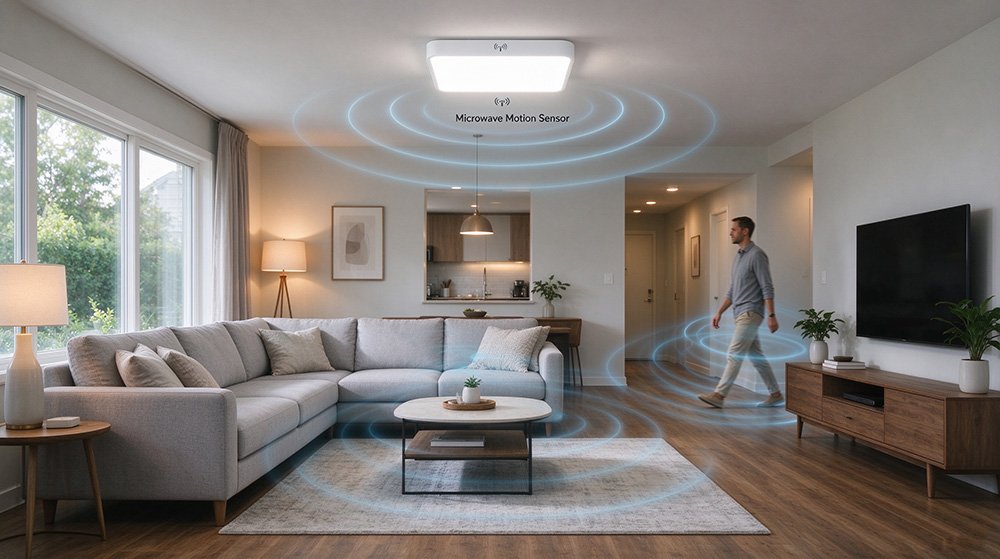
A microwave motion sensor detects movement by transmitting electromagnetic waves and analyzing the signals reflected by objects in its detection area.
Many microwave sensors operate using the Doppler effect. When a moving object changes the reflected signal’s frequency, the sensor can identify the change and trigger the connected lighting system.
Unlike PIR sensors, microwave sensors actively emit a detection signal. This difference affects their detection characteristics and how they interact with walls, furniture, and other materials.
How Does a Microwave Sensor Work in LED Lighting?
A typical microwave motion sensor lighting system follows a similar control sequence:
1. Signal transmission:The sensor emits low-power microwave signals into the surrounding area.
2. Signal analysis:The sensor receives reflected signals and evaluates changes associated with movement.
3. Light activation:When movement meets the sensor’s detection criteria, the control circuit activates the LED light.
Microwave sensors can detect movement through some non-metallic materials, depending on the sensor design, frequency, material thickness, and installation conditions. This can be useful when a sensor needs to be concealed behind a plastic cover or integrated into a lighting fixture.
However, this capability also creates a potential disadvantage: the sensor may detect movement beyond the intended area if its sensitivity and installation are not carefully controlled.
Microwave sensors are commonly considered for offices, warehouses, corridors, parking facilities, and other applications requiring automatic lighting control.
PIR Motion Sensor vs. Microwave Motion Sensor: Key Differences
Although both technologies automate LED lighting, their sensing mechanisms create several practical differences.
Comparison factor | PIR motion sensor | Microwave motion sensor |
Detection principle | Detects changes in infrared radiation | Transmits and analyzes reflected microwave signals |
Active or passive | Passive sensing | Active sensing |
Movement detection | Responds to changing infrared patterns | Responds to changes in reflected signals |
Detection through materials | Generally requires a suitable field of view | Can detect through some non-metallic materials |
Sensitivity to environmental conditions | Can be affected by temperature contrast and heat sources | Can be affected by interference, movement outside the target area, and installation conditions |
False-trigger potential | Possible from heat-related changes or unsuitable placement | Possible from movement outside the target area or reflected signals |
Power consumption | Usually low | Depends on sensor design and electronics |
Typical applications | Wardrobes, cabinet lights, residential spaces | Offices, warehouses, corridors, larger areas |
Privacy | Does not capture images | Does not capture images, but actively transmits sensing signals |
Installation considerations | Requires appropriate field of view | Requires careful adjustment of range and sensitivity |
Neither technology is universally better. The best choice depends on the detection area, expected movement, surrounding materials, lighting requirements, and desired level of control.
1. Detection Range and Coverage
Detection range is one of the most important differences to consider when selecting a motion sensor for LED lighting.
PIR sensors typically work best when a moving person crosses their detection zones within the sensor’s field of view. Their effective range and coverage depend on the lens, sensor design, mounting height, and direction of movement.
Microwave sensors can offer broad coverage and may detect movement through certain non-metallic materials. Their actual range depends on transmission power, antenna design, sensitivity settings, and the surrounding environment.
For a small wardrobe or cabinet, a broad detection range may be unnecessary. A sensor that reliably detects a person opening the cabinet or reaching for an item may be more useful than one that reacts to movement across the entire room.
For a warehouse or large corridor, wider coverage may be beneficial. However, excessive range can also cause unwanted activation, so the sensor must be matched to the required detection zone.
2. Sensitivity to Environmental Conditions
PIR sensors depend on changes in infrared radiation. Their performance can therefore be affected by the temperature difference between a moving person and the background.
In environments where the background temperature is close to body temperature, detection performance may differ from that in cooler environments. Direct sunlight, heat sources, and unsuitable positioning can also affect reliability.
Microwave sensors do not rely on infrared temperature differences in the same way. This can make them useful in certain environments where PIR performance is less predictable.
Nevertheless, microwave sensors are not immune to environmental effects. Moving machinery, fans, moving objects outside the intended zone, and reflections from nearby surfaces may contribute to unwanted triggers, depending on the system.
For outdoor LED lighting, neither technology should be selected based on sensor type alone. Weather protection, temperature limits, mounting position, sensitivity adjustment, and the control system all influence reliable operation.
3. Can the Sensor Detect Movement Through Walls?
This is an important distinction for installations where the sensor is hidden inside a light fixture or behind a cover.
PIR sensors generally need an appropriate optical path to the target area. A conventional PIR sensor cannot detect a person through an opaque wall because the wall blocks the relevant infrared radiation.
Microwave signals, by contrast, can pass through some non-metallic materials. As a result, a microwave sensor may detect movement through certain thin partitions, plastic covers, or other suitable materials.
However, the result depends on material composition, thickness, sensor frequency, antenna design, and installation geometry. Metal surfaces generally block or strongly affect microwave signals.
For manufacturers developing sensor-integrated LED cabinet lights or wardrobe lights, this distinction matters. A concealed microwave sensor may allow a cleaner product appearance, but unwanted detection outside the intended cabinet or room may need to be addressed through shielding, placement, and sensitivity adjustment.
4. False Triggers and Detection Reliability
A motion sensor must do more than detect movement. It must detect the right movement in the right area.
PIR sensors may trigger unexpectedly when changing heat patterns or moving warm objects affect their detection zones. Poor positioning and unsuitable sensor lenses can also reduce reliability.
Microwave sensors may respond to movement outside the intended area because their signals can extend beyond the visible space. Depending on the environment, reflections and moving equipment may also contribute to unwanted activation.
For both technologies, the following design considerations can improve performance:
- Select a sensor with a suitable detection angle and range.
- Install it at the recommended height and orientation.
- Adjust sensitivity to match the actual application.
- Set an appropriate light-on duration.
- Test the sensor under real operating conditions.
- Add daylight sensing where lights should remain off during bright periods.
For a commercial installation, repeated false activation can reduce energy savings and frustrate occupants. For a cabinet light, it may cause unnecessary battery use or shorten the practical operating time between charges.
5. Energy Efficiency and Power Consumption
Both PIR and microwave sensors can reduce LED lighting energy consumption by switching lights off when movement is no longer detected.
However, the savings depend on how the lighting system is configured and used, not just on the sensor technology.
PIR sensors often have low standby power requirements, which can be an advantage in battery-powered cabinet lights and rechargeable lighting products. Microwave sensors require active signal generation and processing, although actual power consumption varies considerably by model.
For rechargeable LED lighting, the sensor’s standby consumption is especially important because the sensor may remain active even when the light is off.
When evaluating a product, compare the sensor’s standby power, the LED’s wattage, the duration of each activation, and the expected number of activations per day. These factors provide a more realistic picture of energy consumption than choosing a sensor based on its name alone.
Which Motion Sensor Is Better for Different LED Lighting Applications?
The following recommendations provide a starting point rather than a universal rule.
LED Cabinet and Wardrobe Lights
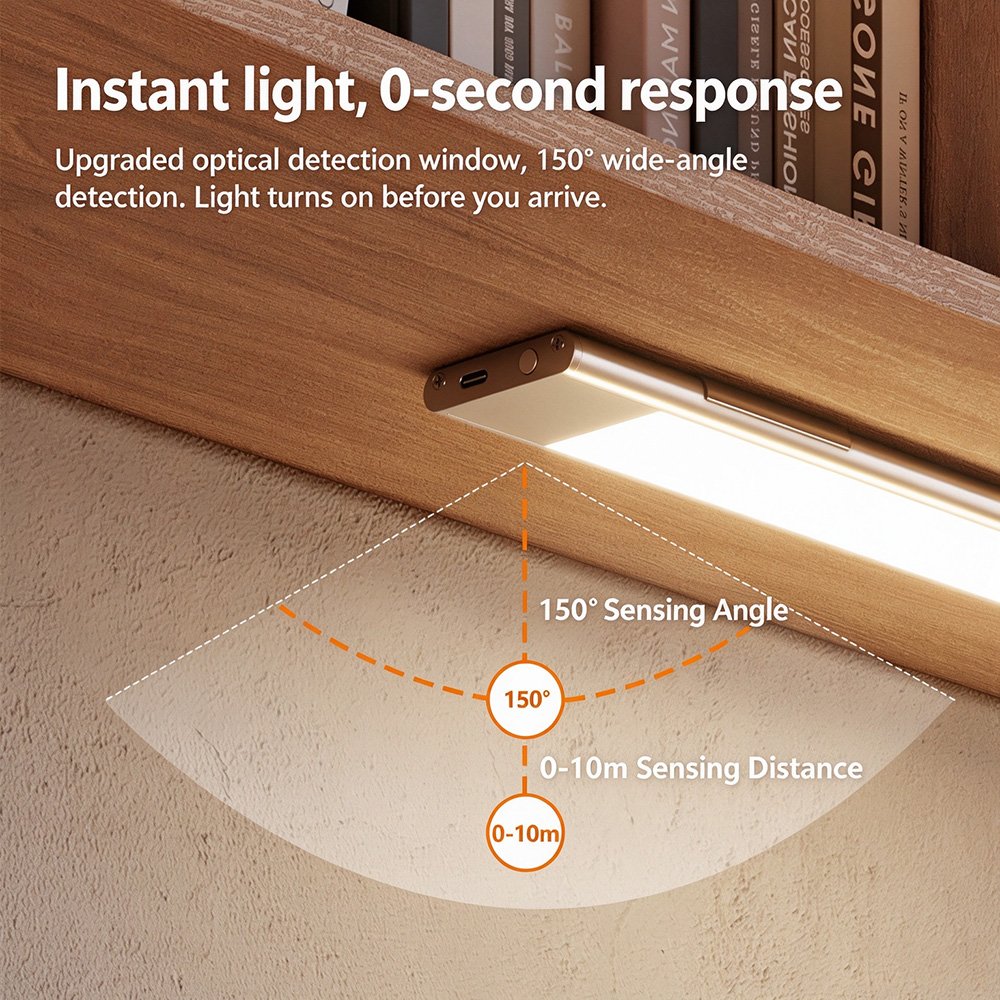
PIR sensors are often a practical choice for cabinet and wardrobe lighting, especially when the sensor can be positioned to detect a person opening a door or reaching into the storage area.
Microwave sensors may be useful when the sensor needs to be concealed behind a suitable non-metallic cover. However, their range must be controlled to avoid activating the light in response to movement outside the cabinet.
The right solution depends on cabinet construction, installation geometry, and whether the light is battery-powered, rechargeable, or hardwired.
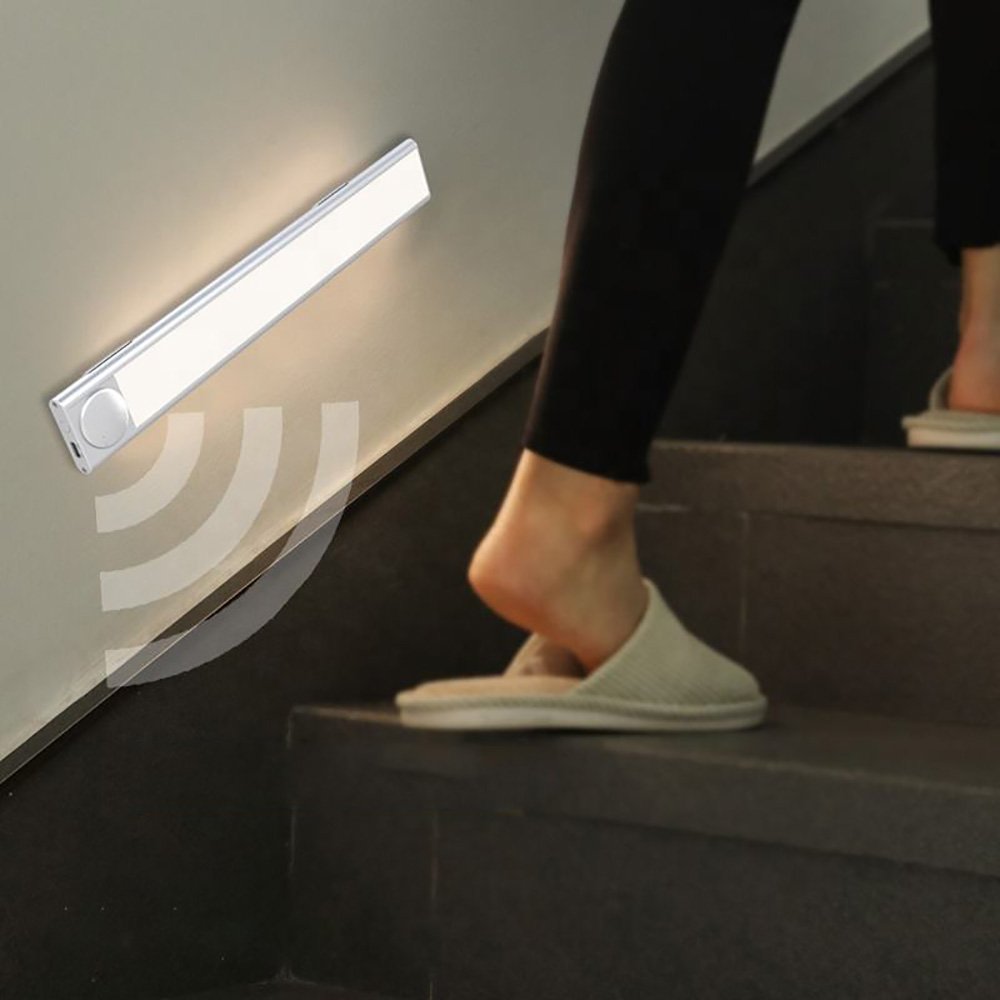
Hallway and Staircase Lighting
Both sensor types can work well in hallways and staircases.
PIR is a reasonable choice when movement occurs within a clearly defined field of view. Microwave sensing may be beneficial when a broader detection pattern is required or when the sensor must be concealed.
In either case, reliable activation, suitable light-on duration, and adequate illumination are essential for safe navigation.
Office and Commercial Lighting
Microwave sensors are often considered for offices, corridors, and commercial spaces because they can be integrated into concealed or ceiling-mounted systems. PIR sensors are also widely used in occupancy-control applications.
For offices, the choice should account for room layout, partition materials, desk arrangements, HVAC movement, and the lighting control strategy. A sensor that detects movement in an adjacent room may waste energy rather than save it.
Outdoor Security and Entrance Lighting
PIR sensors are commonly used for residential security and entrance lighting because they can provide targeted detection when positioned correctly.
Microwave sensors may also be suitable for selected outdoor applications, but the detection range and false-trigger behavior must be evaluated carefully. Weather resistance, operating temperature, and compatibility with the LED driver are equally important.
How to Choose the Right Sensor for an LED Lighting Product
For lighting brands, OEM/ODM buyers, and project developers, selecting a motion sensor involves more than choosing PIR or microwave technology.
First, define the required detection zone. A small cabinet, a long corridor, and an open warehouse require different sensing characteristics.
Second, consider the installation method. If the sensor must sit behind a cover, check whether the material is compatible with the chosen technology. If the sensor has a direct line of sight to the target area, a conventional PIR design may be sufficient.
Third, evaluate the power supply. Battery-powered products require careful management of standby consumption, while hardwired systems may allow greater flexibility in sensor selection and control features.
Finally, test the complete lighting product rather than the sensor alone. Sensor placement, the LED driver, housing materials, control logic, light-on duration, and sensitivity settings all affect the finished product’s performance.
For manufacturers, customization may include detection range, sensing angle, daylight thresholds, time delay, mounting position, and the type of control interface used by the LED lighting system.
Conclusion
The main difference between a PIR motion sensor and a microwave motion sensor lies in how each technology detects movement. PIR sensors monitor changes in infrared radiation, while microwave sensors transmit electromagnetic waves and analyze their reflections.
PIR motion sensors are often suitable for targeted residential applications, including cabinet and wardrobe lights. Microwave sensors can be useful where concealed installation or broader detection coverage is needed, provided unwanted activation can be controlled.
When choosing PIR motion sensor LED lighting, evaluate the actual application, detection range, standby power, installation environment, and required control functions. The most effective solution is not necessarily the sensor with the widest range or highest sensitivity, but the one that reliably detects intended movement while keeping the LED lighting system convenient, efficient, and dependable.