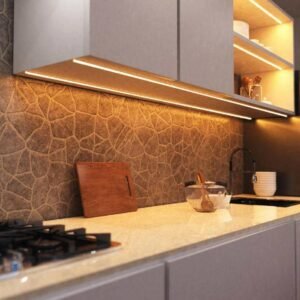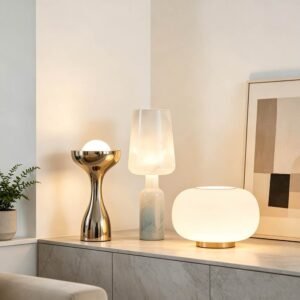

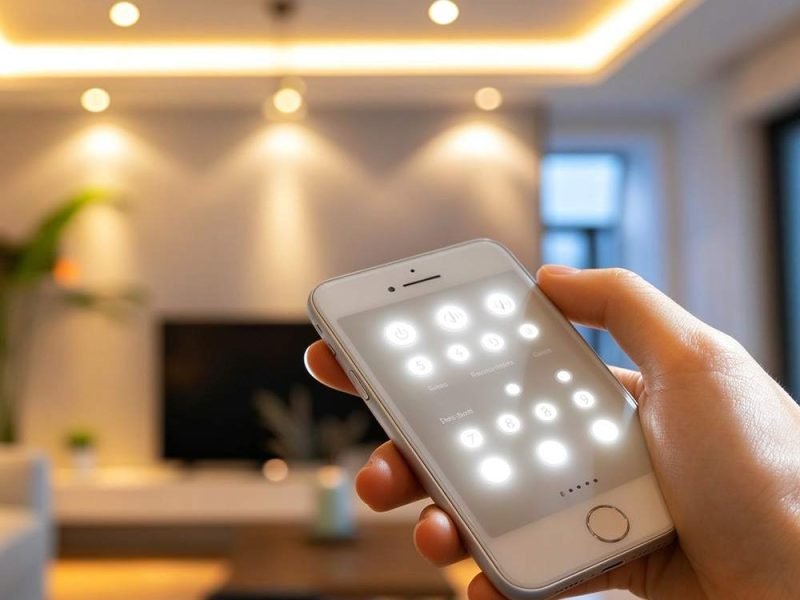
Lighting is no longer just about switching a lamp on or off. Modern homes can use intelligent lighting systems to adjust brightness, change color temperature, detect movement, follow daily schedules, and respond to voice commands. These features make everyday lighting more convenient while helping homeowners create different atmospheres for working, relaxing, entertaining, and sleeping.
With the development of connected LED products, smart lighting control has become an important part of modern home lighting design. From a simple remote-controlled table lamp to a whole-home lighting system managed through a smartphone, there are several ways to control lighting intelligently.
But which method is right for your home? Understanding the different smart lighting control methods, their advantages, and their limitations will help you build a system that matches your lifestyle and budget.
What Is Smart Lighting Control?
Smart lighting control refers to using electronic controls, sensors, wireless communication, or automated rules to manage lighting behavior beyond basic manual switching.
Depending on the system, users may control individual lights or groups of fixtures through a mobile app, remote control, voice assistant, wall panel, motion sensor, or preset schedule.
For example, you could dim your bedroom lights before going to sleep, turn on hallway lights automatically when movement is detected, or adjust the color temperature of a living room lamp for reading.
Most smart lighting systems use LED technology because LEDs are energy-efficient, respond quickly to control signals, and are compatible with a wide range of dimming and color-adjustment technologies.
However, not every LED light is automatically smart. The fixture, driver, controller, and control method must be compatible with one another for the intended functions to work correctly.
1. Smartphone App Control
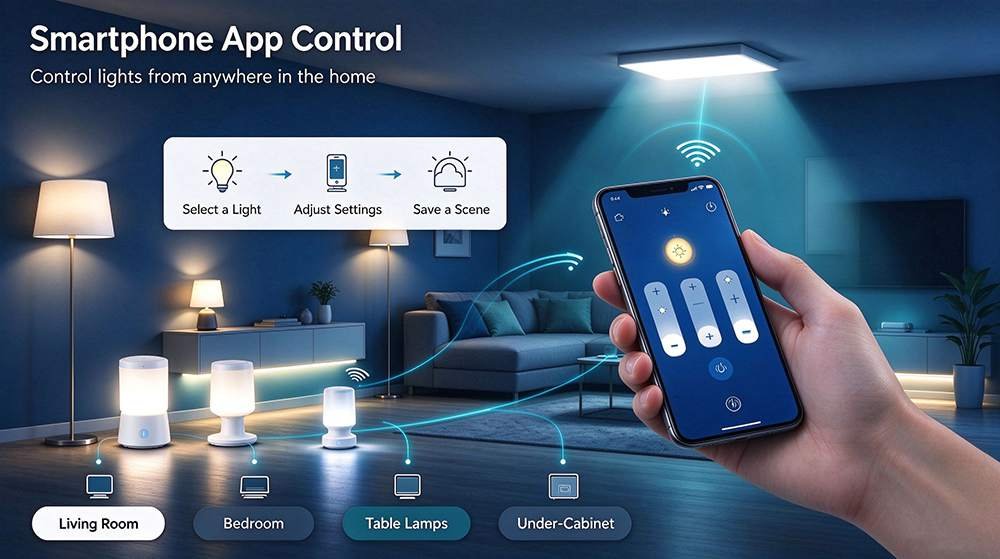
Smartphone app control is one of the most flexible methods of managing smart lighting. Depending on the product, users can turn lights on or off, adjust brightness, change color temperature, select colors, create schedules, and group multiple fixtures.
Some products connect directly to a phone through Bluetooth, while others use Wi-Fi, a dedicated hub, or another supported wireless protocol.
How does it work?
A compatible LED light communicates with a mobile app through its supported connection. When a user changes a setting, the command is sent to the light or its control system, which adjusts the output accordingly.
For example, a smart LED table lamp might offer adjustable warm and cool white settings. Users can select warm light for relaxing in the evening and cooler light when they want a brighter, more neutral appearance.
Best applications
App control is particularly useful for:
- Living rooms with several smart lights.
- Bedrooms with adjustable bedside lighting.
- LED table lamps and floor lamps.
- Under-cabinet and wardrobe lighting with configurable functions.
- Homes where lighting schedules or multiple scenes are desirable.
The main advantage is flexibility. However, buyers should check whether the system requires an internet connection, a hub, or a particular app. Remote control from outside the home may require internet access, while local Bluetooth control generally has a more limited range.
2. Remote Control
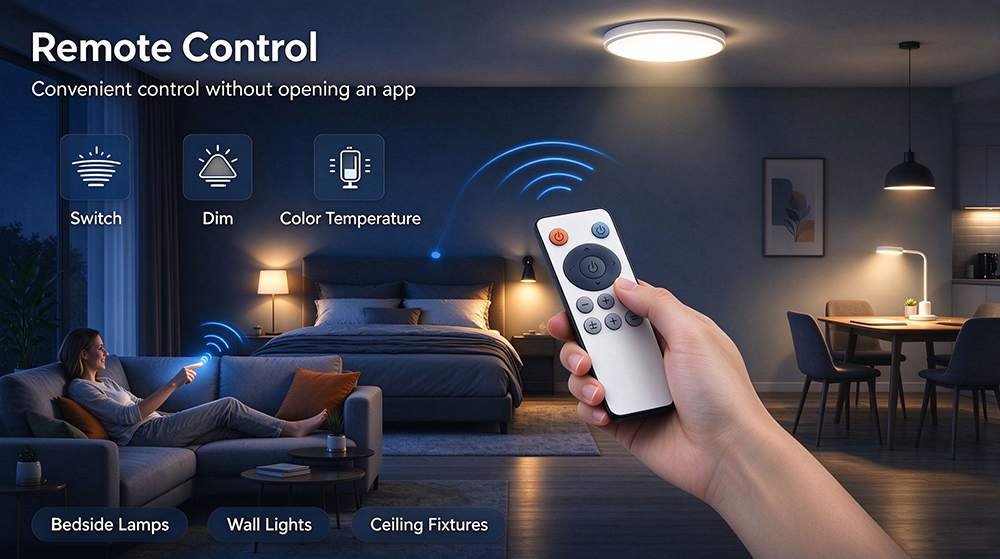
Remote control is a straightforward option for people who want convenient lighting adjustments without opening a smartphone app.
Depending on the product, a remote may use infrared, radio frequency, or another wireless communication method. Available functions can include switching, dimming, color-temperature adjustment, color selection, and preset lighting modes.
Unlike a wall switch, a remote lets users change lighting settings from a sofa, bed, or dining table without getting up.
When should you choose remote-controlled lighting?
Remote control is particularly practical for bedside lamps, decorative wall lights, ceiling fixtures, and rechargeable table lamps.
For example, a restaurant using rechargeable LED table lamps may prefer remote control to adjust the brightness of multiple tables before service. A homeowner may use a remote-controlled wall light to dim the lighting while watching a movie.
Remote controls are also useful for people who prefer simple physical buttons over app-based interfaces.
The main limitation is that one remote may not work with every lighting product. Before purchasing, confirm compatibility, operating range, available functions, and whether one controller can manage multiple fixtures.
3. Voice Control
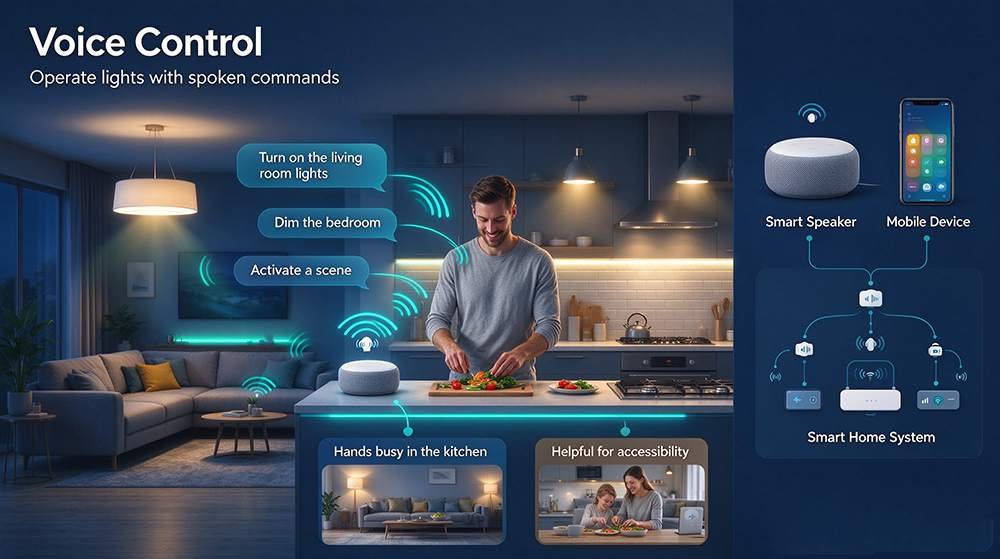
Voice control allows users to operate compatible lighting through a voice assistant or smart home platform.
Instead of reaching for a switch or phone, a user can issue a command such as turning on the living room lights, dimming the bedroom, or activating a predefined scene.
Voice control generally works through compatible smart speakers, mobile devices, or integrated smart home systems. The supported functions depend on the lighting product and the platform it connects to.
Advantages of voice-controlled lighting
Voice control can be convenient when your hands are occupied, such as when cooking, carrying groceries, or getting ready for bed. It can also improve accessibility for people who find physical switches difficult to use.
For example, kitchen lighting could be switched on through a voice command while preparing food. In a bedroom, users might activate a low-brightness scene without searching for a remote in the dark.
However, voice control usually requires compatible devices and suitable network or platform settings. It should complement rather than replace manual controls, particularly in homes where multiple people use the same lighting system.
4. Motion Sensor and Occupancy-Based Control
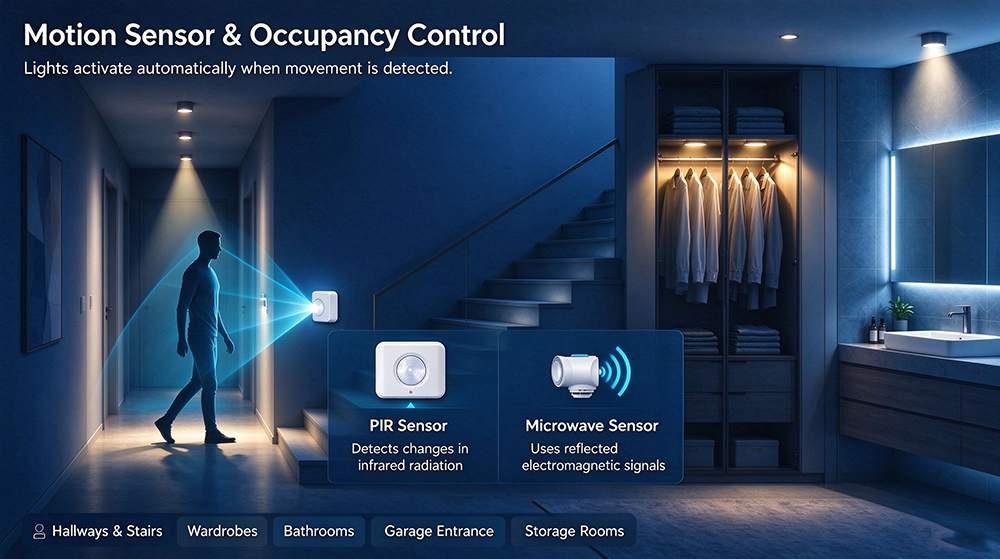
Motion sensor lighting automatically activates when movement is detected. It is especially useful in spaces where people enter briefly or may not remember to switch off the lights.
Two common sensing technologies are PIR and microwave sensors.
PIR sensors detect changes in infrared radiation associated with moving people or objects. Microwave sensors transmit electromagnetic signals and analyze their reflections to identify movement.
Both can be used in LED lighting, but their detection characteristics differ. PIR is often suitable for clearly defined residential areas, while microwave sensing can be useful where concealed installation or broader coverage is required. Actual performance depends on sensor design and the environment.
Where is sensor-controlled lighting useful?
Motion-activated LED lighting is commonly used in:
- Hallways and staircases.
- Wardrobes and cabinets.
- Bathrooms and utility rooms.
- Garage entrances.
- Storage rooms and selected outdoor areas.
For example, an LED wardrobe light can activate when the door opens or when movement is detected, making it easier to find clothing without switching on the main bedroom light.
When choosing this method, consider detection range, sensitivity, activation duration, standby power consumption, and whether daylight sensing is available. Excessive sensitivity can cause unwanted activation, while insufficient sensitivity may leave users in the dark.
5. Schedule-Based and Automated Lighting
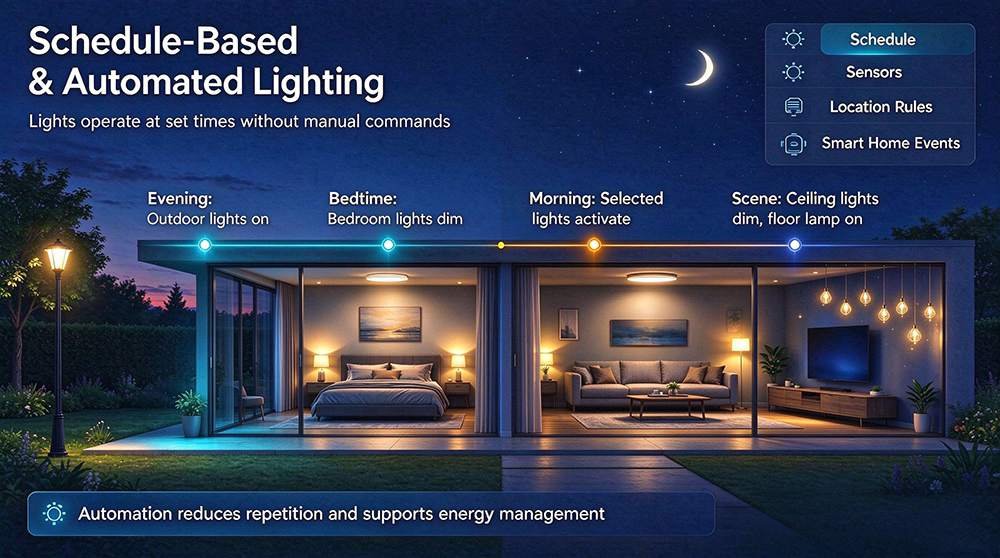
Scheduling allows lights to operate at specific times without requiring a manual command each time. More advanced systems combine schedules with sensors, location rules, or other smart home events.
For example, outdoor lights could turn on in the evening and switch off at a set time. Bedroom lights might gradually dim as bedtime approaches, while selected lights could activate in the morning.
Automation can also coordinate several fixtures. A single scene might dim the living room ceiling lights, switch on a floor lamp, and adjust a decorative wall light to create a consistent atmosphere.
Why use automated lighting?
Automation reduces repetitive manual actions and makes lighting behavior more predictable. It can also help manage energy use by preventing lights from remaining on unnecessarily.
However, automation works best when the rules match actual household routines. A rigid schedule may be inconvenient when people work irregular hours or use rooms differently from day to day.
Look for systems that allow schedules to be edited easily and provide manual overrides when needed.
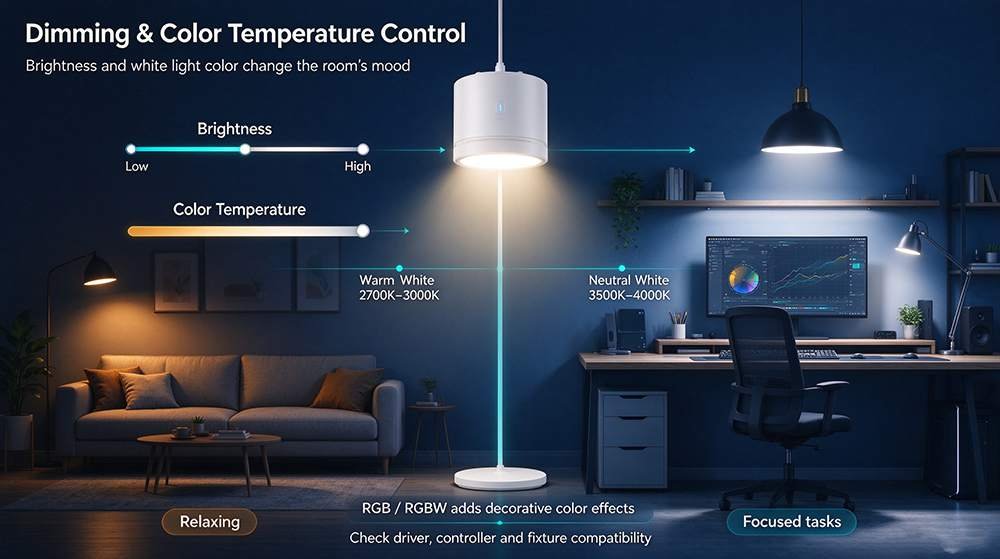
6. Dimming and Color Temperature Control
Smart lighting control is not only about switching lights on and off. Adjusting brightness and color temperature can significantly change how a room looks and feels.
Brightness control changes the light output to suit different activities. Higher brightness may be useful for cleaning or detailed tasks, while lower brightness can create a more relaxed atmosphere.
Color temperature control changes the appearance of white light, usually measured in kelvin (K). Warm white around 2700K–3000K is commonly used for cozy residential spaces. Neutral white around 3500K–4000K can suit kitchens and multipurpose rooms, depending on the desired appearance.
Some products also provide RGB or RGBW color control, allowing users to create decorative lighting effects.
Not every smart LED light supports all these functions. A dimmable product may not offer adjustable color temperature, and a tunable-white light is not necessarily capable of producing colored light.
Compatibility between the LED driver, controller, and fixture is essential for smooth dimming and reliable color adjustment.
Comparison of Smart Lighting Control Methods
Control method | Main advantage | Potential limitation | Suitable applications |
Smartphone app | Flexible settings and grouping | May require a hub, network, or app | Whole-home lighting, smart lamps |
Remote control | Simple physical operation | Compatibility and range vary | Table lamps, wall lights, dining areas |
Voice control | Hands-free convenience | Requires compatible devices and setup | Living rooms, bedrooms, kitchens |
Motion sensor | Automatic activation | May trigger incorrectly if poorly configured | Wardrobes, hallways, bathrooms |
Scheduling and automation | Consistent, hands-off operation | Requires suitable rules and configuration | Outdoor lights, daily routines |
Dimming and color control | Personalized atmosphere | Requires compatible LEDs and controls | Bedrooms, living rooms, decorative lighting |
These methods are not mutually exclusive. A smart LED wall light, for example, may support app control, remote dimming, and scheduled operation at the same time.
How to Choose the Right Smart Lighting Control System
Before buying smart lighting products, consider the following factors.
1. Start with Your Lighting Needs
Identify what you want the system to do. If you simply need convenient brightness adjustment, a remote-controlled lamp may be sufficient. If you want multiple lights to work together, app control and automation may be more appropriate.
2. Check Compatibility
Confirm that the fixture, driver, controller, app, and smart home platform work together. Wireless protocols and supported functions differ across products, so do not assume that all smart lights can connect to the same system.
3. Consider Installation and Power Supply
Some smart lamps work through a standard outlet, while integrated fixtures may require hardwiring or a compatible wall controller. Motion sensor lights may also be battery-powered or rechargeable.
Choose an installation method that suits the room and consider how the product will be maintained over time.
4. Prioritize Reliability and Ease of Use
A system with many features is not necessarily the best choice if it is difficult to configure. Check whether manual controls remain available, how the light behaves after a power interruption, and whether multiple users can operate it conveniently.
5. Evaluate Energy Use Realistically
LED technology and automated controls can reduce unnecessary lighting, but actual savings depend on usage patterns, standby consumption, brightness settings, and the time lights remain on.
For sensor-controlled products, standby power can be particularly relevant when the light is battery-powered.
SENWELL Smart Lighting Control Solutions for Your Business
Choosing the right smart lighting control method is only part of developing a successful lighting product. For lighting brands, wholesalers, and project buyers, the ability to customize control functions around specific user needs can make a product more competitive in the market.
SENWELL provides customized smart lighting control design and development solutions for B2B customers. Whether you need app-controlled lighting, remote control, voice control, PIR or microwave motion sensing, scheduled automation, or adjustable brightness and color temperature, our team can work with your ideas to develop a suitable solution for your lighting products.
Through our OEM and ODM services, we help customers integrate the appropriate control methods into different types of LED lighting, including cabinet lights, wardrobe lights, table lamps, and wall lights. Control functions can be tailored to the intended application, product structure, and target market, helping you develop lighting products that offer greater convenience, flexibility, and differentiation.
If you are planning to launch a new smart lighting product or upgrade an existing design, SENWELL can support your project from concept development and control-function customization to prototyping and mass production. Contact our team to discuss your smart lighting control requirements and explore a solution tailored to your business.
Conclusion
Modern smart lighting control gives homeowners more ways to manage illumination according to their activities, schedules, and preferences. Smartphone apps provide flexible adjustment, remote controls offer simple operation, voice control enables hands-free use, and sensors automate lighting when movement is detected.
For many homes, the most practical solution is a combination of methods rather than a single control technology. A bedroom might use app-based dimming, a wardrobe could benefit from motion sensing, and outdoor lights may work best with automatic schedules.
The key is to choose compatible LED products and control methods that solve real everyday problems. With suitable fixtures, reliable controls, and thoughtful configuration, smart lighting can make a home more convenient, adaptable, and energy-conscious without adding unnecessary complexity.