
If you have ever looked at your electricity bill and wondered which appliances are using the most energy, you may have also wondered about your lighting.
After all, a home can have dozens of lights. Add ceiling lights, table lamps, under cabinet lighting, wall lights, LED strips, outdoor lighting and decorative fixtures, and it is easy to imagine that keeping all of them on could consume a significant amount of electricity.
But do LED lights actually use a lot of electricity?
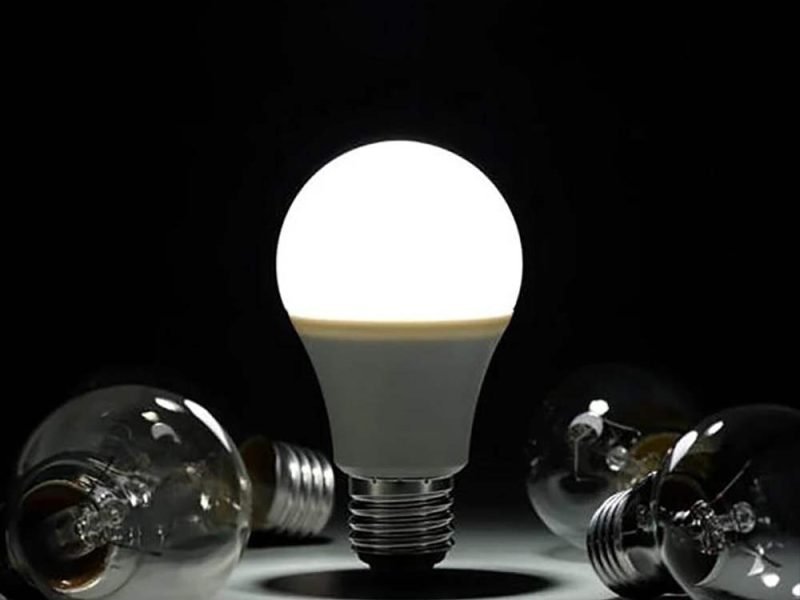
Generally, no. LED lights are one of the most energy-efficient lighting technologies available today. A properly selected LED can provide similar brightness to a traditional incandescent bulb while using a fraction of the power.
The U.S. Department of Energy, for example, lists an 800-lumen incandescent bulb at around 60 watts, while comparable LED products can provide the same light output using roughly 5.9–10.5 watts.
However, that does not mean every LED light automatically uses very little electricity. Wattage, brightness, operating time, product design, LED density, driver efficiency and smart features can all affect actual energy consumption.
So, how much electricity do LED lights really use?
How Much Electricity Do LED Lights Use?
The easiest way to understand LED electricity consumption is to start with watts (W).
Watts indicate how much electrical power a light uses while operating. The higher the wattage, the more electricity the light consumes for each hour of operation.
For example:
- A 5W LED uses 5 watts of power.
- A 10W LED uses 10 watts.
- A 20W LED uses 20 watts.
- A 40W LED uses 40 watts.
But wattage alone doesn’t tell you how much light a product produces.
That’s where lumens come in.
Lumens measure the amount of visible light produced by a light source. When comparing energy efficiency, it is therefore better to ask:
How much light do I get for each watt of electricity?
This is called luminous efficacy and is expressed in lumens per watt (lm/W).
For example, an LED producing 1,000 lumens from 10 watts has an efficacy of 100 lm/W.
A more efficient LED can produce the same amount of light while consuming less electricity.
The Department of Energy notes that modern LED lighting products can reach very high efficacy levels, with specialized products exceeding 150 lumens per watt.
LED Lights vs. Incandescent Bulbs: How Big Is the Difference?
The easiest way to see the energy advantage of LEDs is to compare them with incandescent lighting.
Imagine that you need approximately 800 lumens of light.
A traditional incandescent bulb may require around 60 watts to produce this amount of light. A modern LED replacement can provide similar output using roughly 6–10 watts, depending on the product.
That means the LED may use approximately 80–90% less power for a similar amount of light.
Here’s a simplified comparison:
Light Output | Incandescent | LED |
About 450 lumens | 40W | 4.5–7W |
About 800 lumens | 60W | 5.9–10.5W |
About 1,100 lumens | 75W | 9.5–14W |
About 1,600 lumens | 100W | 10.5–18W |
These figures illustrate why replacing traditional incandescent bulbs with LEDs can make a noticeable difference when many lights are used throughout a home or commercial building.
The reason is relatively straightforward.
An incandescent bulb produces light by heating a filament until it becomes extremely hot. A large portion of the electrical energy is therefore released as heat rather than useful visible light.
LEDs use a semiconductor to generate light, allowing much more of the input energy to be converted into useful illumination.
How Much Does It Cost to Run an LED Light?
Wattage tells you the power consumption, but electricity bills are normally based on kilowatt-hours (kWh).
The basic calculation is:
Energy consumption = Wattage × Operating time
Because electricity is usually measured in kilowatt-hours, divide watts by 1,000.
For example, suppose you have a 10W LED light and use it for 8 hours every day.
10W × 8 hours = 80Wh
80Wh ÷ 1,000 = 0.08 kWh per day
Over 30 days:
0.08 × 30 = 2.4 kWh per month
If your electricity rate were $0.20 per kWh, that light would cost:
2.4 × $0.20 = $0.48 per month
Even if the light operated for 8 hours every day, the electricity cost would still be relatively small.
Of course, electricity prices vary considerably by location, so the actual cost will depend on your local utility rate.
What If You Have Many LED Lights?
One LED light may use very little electricity, but what happens when you have 20, 30 or even 50?
Let’s say a home has 20 LED lights, each rated at 10W.
If all 20 lights are switched on for 5 hours per day:
20 × 10W = 200W
200W × 5 hours = 1,000Wh
That’s:
1 kWh per day
Over 30 days:
30 kWh per month
At an electricity rate of $0.20/kWh, that would be approximately:
$6 per month
This is one reason LEDs are particularly attractive for homes, offices, hotels, retail stores and other buildings where many lights operate every day.
The savings become even more noticeable when LEDs replace high-wattage incandescent or halogen lighting.
Do LED Strip Lights Use a Lot of Electricity?
This is a slightly different question.
A single LED bulb might consume only 8–12W, but an LED strip can be several meters long and contain hundreds of individual LEDs.
Therefore, you shouldn’t judge the power consumption of an LED strip simply by looking at the number of LEDs.
The key figure is usually watts per meter or watts per foot.
For example, a hypothetical LED strip rated at 10W per meter would consume:
- 1 meter = 10W
- 3 meters = 30W
- 5 meters = 50W
- 10 meters = 100W
So, a 10-meter LED strip can certainly use more electricity than a single LED bulb.
But that does not necessarily mean it is inefficient.
The question is how much useful light you receive for the power consumed.
Govee’s comparison of residential LED products, for example, lists typical LED strip consumption in the range of several watts per meter, while emphasizing that actual consumption varies according to output, technology and configuration.
HitLights similarly notes that LED strip consumption depends on factors such as brightness, strip density and length.
This is why a buyer should always check the manufacturer’s actual wattage specification before calculating the power requirement of an LED strip installation.
Does a Longer LED Strip Use More Electricity?
Yes.
If the power rating is specified per meter, increasing the length increases total power consumption.
For example, consider a 12W/m LED strip:
Strip Length | Approx. Power |
1 meter | 12W |
2 meters | 24W |
5 meters | 60W |
10 meters | 120W |
This is also important when selecting a power supply.
A 10-meter strip rated at 12W/m requires approximately 120W of LED power before allowing for an appropriate power-supply margin.
Therefore, the power supply should be selected according to the actual total load rather than simply choosing one based on the voltage.
Does Higher Brightness Mean Higher Electricity Consumption?
Generally, yes.
If you want more light, you usually need more electrical power.
For LED strip lighting, higher-density strips can contain more LEDs per meter and therefore often require more power. Govee notes that LED density and strip length both affect power consumption.
But there’s an important distinction:
More watts do not automatically mean better lighting.
Suppose you install an extremely bright LED strip in a location that only requires subtle decorative illumination. You may be using significantly more electricity than necessary.
For energy efficiency, the goal should not be “use the lowest wattage possible.”
Instead, the goal is:
Use enough light for the application without unnecessarily over-lighting the space.
This is why lumens, beam angle, optical design and light distribution are just as important as wattage.
Does Color Temperature Affect LED Electricity Consumption?
This topic is sometimes misunderstood.
You may see claims that warm-white LEDs always use less electricity than cool-white LEDs. That is not necessarily true for every LED product.
The actual power consumption depends on the LED technology and product design.
HitLights, for example, points out that power consumption can vary according to the particular LED strip rather than simply being determined by color temperature. Its recommendation is to check the manufacturer’s wattage specification for the specific product.
Therefore, don’t assume:
3000K = low power
and
6000K = high power.
Instead, compare the actual wattage and performance specifications.
What About RGB and RGBW LED Lights?
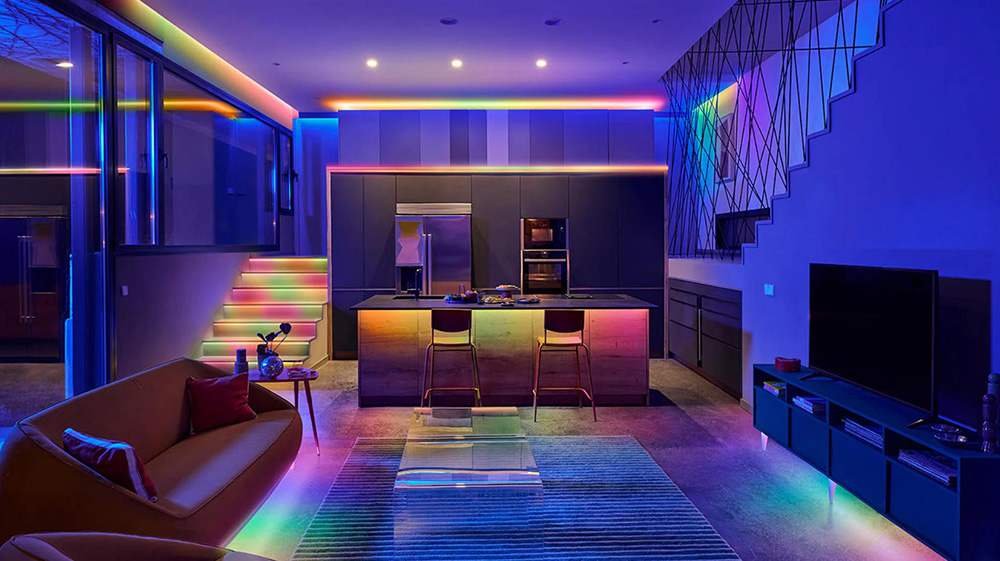
Color-changing LED lights can consume different amounts of power depending on the lighting mode.
An RGB LED system typically combines red, green and blue channels to create different colors.
If only one channel is operating, power consumption may be relatively low. When multiple channels are operating simultaneously at high brightness, total power consumption increases.
RGBW products add a dedicated white LED channel, giving users better white-light performance but also adding another potential power load.
Therefore, if you are purchasing RGB or RGBW LED strips for a large project, don’t calculate energy consumption simply by looking at the strip length.
Check the manufacturer’s maximum wattage per meter and multiply it by the installed length.
Do Smart LED Lights Use More Electricity?
Smart functions require electronics, so a smart LED light can consume a small amount of electricity even when the main LEDs are not producing light.
For example, a Wi-Fi-enabled light may need to remain connected to the network so it can receive commands from an app or smart-home system.
Govee notes that smart lighting can have a small standby power draw, while the amount depends on the product and electronics used.
However, this does not necessarily make smart LED lighting inefficient.
Smart controls can actually reduce total electricity consumption when used properly.
For example:
- Motion sensors can turn lights off when nobody is present.
- Timers can prevent lights from operating unnecessarily.
- Dimming can reduce power when full brightness isn’t required.
- Daylight sensors can reduce artificial lighting during the daytime.
- Smart scheduling can automatically switch off lights overnight.
The U.S. Department of Energy specifically notes that LED lighting can integrate with occupancy sensors, daylight harvesting and lighting controls to achieve additional energy savings.
So a smart LED light may consume a little power while waiting for commands, but intelligent control can save much more energy during actual operation.
Does the LED Driver Affect Electricity Consumption?
Yes, especially for LED strips and low-voltage LED fixtures.
Many LED products require a driver or power supply to convert the available electrical supply into the voltage and current required by the LEDs.
The LED chips themselves may be highly efficient, but losses can occur during power conversion.
Govee highlights driver efficiency as one factor affecting the overall electricity consumption of an LED system.
This means that two LED fixtures with similar LED chips and wattage may not necessarily have identical system-level efficiency.
For commercial and architectural projects, it is therefore useful to consider the efficiency of the complete luminaire, rather than looking only at the LED package.
Does Heat Affect LED Energy Efficiency?
It can.
LEDs are much more efficient than incandescent bulbs, but they still generate heat.
If heat is not properly managed, LED performance, lifetime and efficiency can be affected.
This is why many LED products use:
- Aluminum housings
- Heat sinks
- Aluminum LED channels
- Metal-core PCBs
- Thermal pads
- Properly designed drivers
Govee also identifies heat management as an important factor in LED performance and energy efficiency.
This is particularly important for high-output LED strips and linear lighting.
For example, placing a high-power LED strip inside an enclosed profile without sufficient thermal management may affect its long-term performance.
An aluminum LED channel can help transfer heat away from the LED strip while also improving the appearance and light diffusion of the installation.
How to Choose Energy-Efficient LED Lights
If reducing electricity consumption is your goal, don’t simply search for the lowest-wattage LED.
Instead, consider the complete specification.
1. Compare Lumens and Watts
Look at how much light you receive for the power consumed.
A useful starting point is:
Lumens ÷ Watts = Lumens per Watt
Higher lm/W generally indicates better energy efficiency.
2. Choose the Right Brightness
Don’t install a 2,000-lumen light where 500 lumens would be sufficient.
Oversized lighting systems waste energy even when the LED technology itself is efficient.
3. Check the Actual Wattage
For LED strips, check watts per meter or watts per foot.
For LED bulbs and fixtures, check the rated input power.
4. Look at the Complete Luminaire
For professional projects, consider driver efficiency, optics, thermal management and controls rather than evaluating only the LED chip.
5. Consider Dimming and Sensors
A dimmable LED fixture allows you to reduce output when maximum brightness isn’t needed.
Occupancy sensors and timers can prevent unnecessary operating hours.
6. Choose Quality Products
Low-cost LEDs may appear attractive because of their purchase price, but inconsistent performance, poor drivers and inadequate thermal management can reduce long-term value.
The U.S. Department of Energy emphasizes that LED product performance can vary significantly and recommends comparing products based on measurable performance characteristics rather than simply assuming all LEDs are equivalent.
Are LED Lights Always the Cheapest Lighting Option?
Not necessarily when you look only at the purchase price.
A basic incandescent bulb may cost less to buy than an LED.
But purchase price is only one part of the equation.
Consider:
Initial cost + electricity cost + replacement cost + maintenance
LEDs generally perform well across all four categories.
The Department of Energy notes that quality LED lighting products typically have useful lives of around 30,000–50,000 hours or longer, while incandescent lamps are generally around 1,000 hours.
This means an LED may cost more initially but require significantly less electricity and fewer replacements over its service life.
For commercial lighting, the difference can become particularly significant because maintenance and labor costs can be much more important than the original lamp price.
Do You Need to Turn LED Lights Off to Save Electricity?
Yes.
LEDs are efficient, but they are not free to operate.
A 10W LED still uses electricity whenever it is running.
If you leave 20 of those lights on unnecessarily for 10 additional hours every day, the energy consumption adds up.
The good news is that LED technology makes automated control easier.
Motion sensors, occupancy sensors, timers, dimmers and smart-home systems can all help ensure that lighting is used when it is actually needed.
So the best energy-saving strategy isn’t simply:
“Buy LEDs and forget about electricity.”
It is:
“Use efficient LEDs and control when, where and how brightly they operate.”
Final Answer: Do LED Lights Use a Lot of Electricity?
No, LED lights generally do not use a lot of electricity compared with traditional lighting technologies.
An LED can produce similar brightness to an incandescent bulb while consuming dramatically less power. For example, an 800-lumen incandescent bulb may require around 60W, while a comparable LED can operate at roughly 6–10W.
However, actual electricity consumption depends on the entire lighting system.
The biggest factors include:
- Wattage
- Brightness
- Operating hours
- Number of lights
- LED strip length
- LED density
- Driver efficiency
- Smart functions
- Dimming
- Thermal management
For ordinary residential lighting, replacing incandescent bulbs with LEDs can significantly reduce electricity consumption. For larger projects, the savings can become even more substantial when efficient LED fixtures are combined with dimming, occupancy sensing and smart controls.
So, if you’re worried about your electricity bill, LED lights are generally not the problem.
In many cases, switching to LED lighting is actually part of the solution.