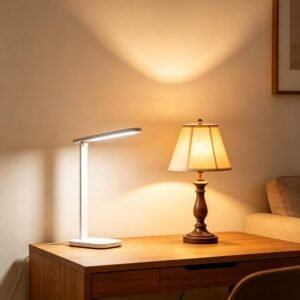


When choosing an LED lighting product, buyers often focus on wattage, lumens, size, beam angle, or price. But there is another specification that can completely change the appearance of a space: color temperature.
Choose 2700K for the right room, and the space can feel warm, comfortable, and inviting. Choose 5000K in the same room, and suddenly the atmosphere may feel much more energetic—and perhaps a little too much like a showroom.
Neither option is necessarily wrong. The key is matching the color temperature to the purpose of the space.
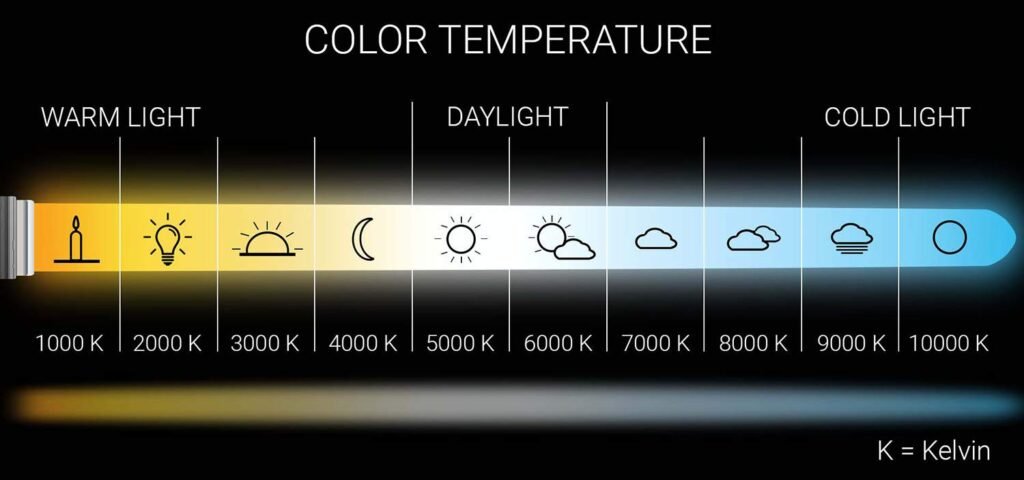
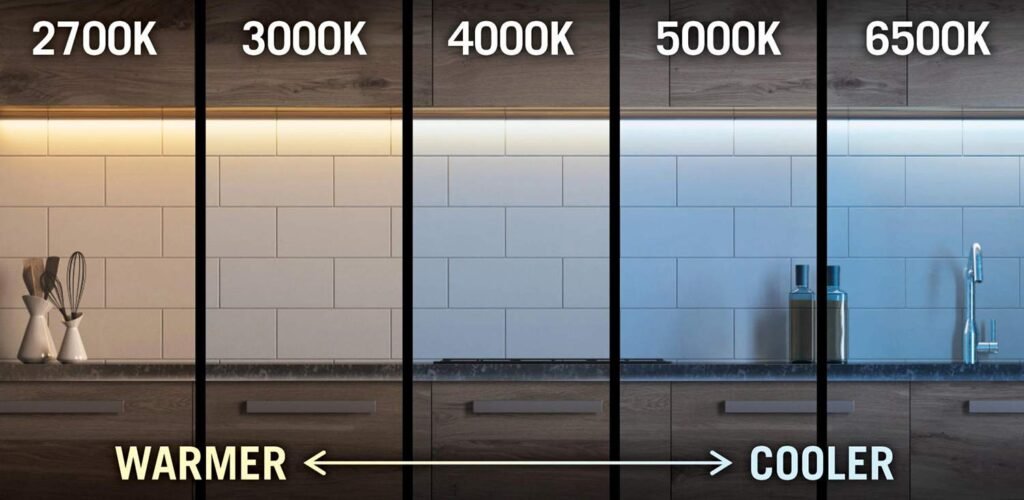
Color temperature is measured in Kelvin (K). Lower Kelvin values produce warmer-looking light, while higher values produce cooler-looking light. For example, 2700K and 3000K generally appear warm and yellowish, while 4000K looks more neutral and 5000K–6500K produces a cooler, daylight-like appearance.
So, how should you choose the right color temperature when purchasing an LED lighting product?
Let’s take a practical look.
What Is LED Lighting Color Temperature?
Color temperature describes the visual color of white light rather than how hot the LED fixture physically becomes.
It is expressed in Kelvin:
Color Temperature | General Appearance | Typical Applications |
2200K | Very warm, candle-like | Decorative, hospitality, outdoor ambiance |
2700K | Warm white | Bedrooms, living rooms, restaurants |
3000K | Warm but cleaner | Residential, hotels, wall lights |
3500K | Soft neutral | Offices, retail, kitchens |
4000K | Neutral white | Offices, kitchens, bathrooms, commercial spaces |
5000K | Cool/daylight white | Workshops, garages, warehouses |
5700–6500K | Very cool/daylight | Industrial, inspection, specialty applications |
As the Kelvin number increases, the light generally appears cooler and more blue-white.
This can seem counterintuitive at first. You might expect a higher “temperature” to mean warmer light, but color temperature is based on the appearance of a theoretical heated object rather than the actual operating temperature of the LED.
Parmida LED similarly explains that lower Kelvin values tend toward yellow or warm tones, while higher values produce whiter or cooler light.
2700K, 3000K, 4000K or 5000K: Which One Should You Choose?
For most LED lighting projects, the decision can be simplified into three broad groups:
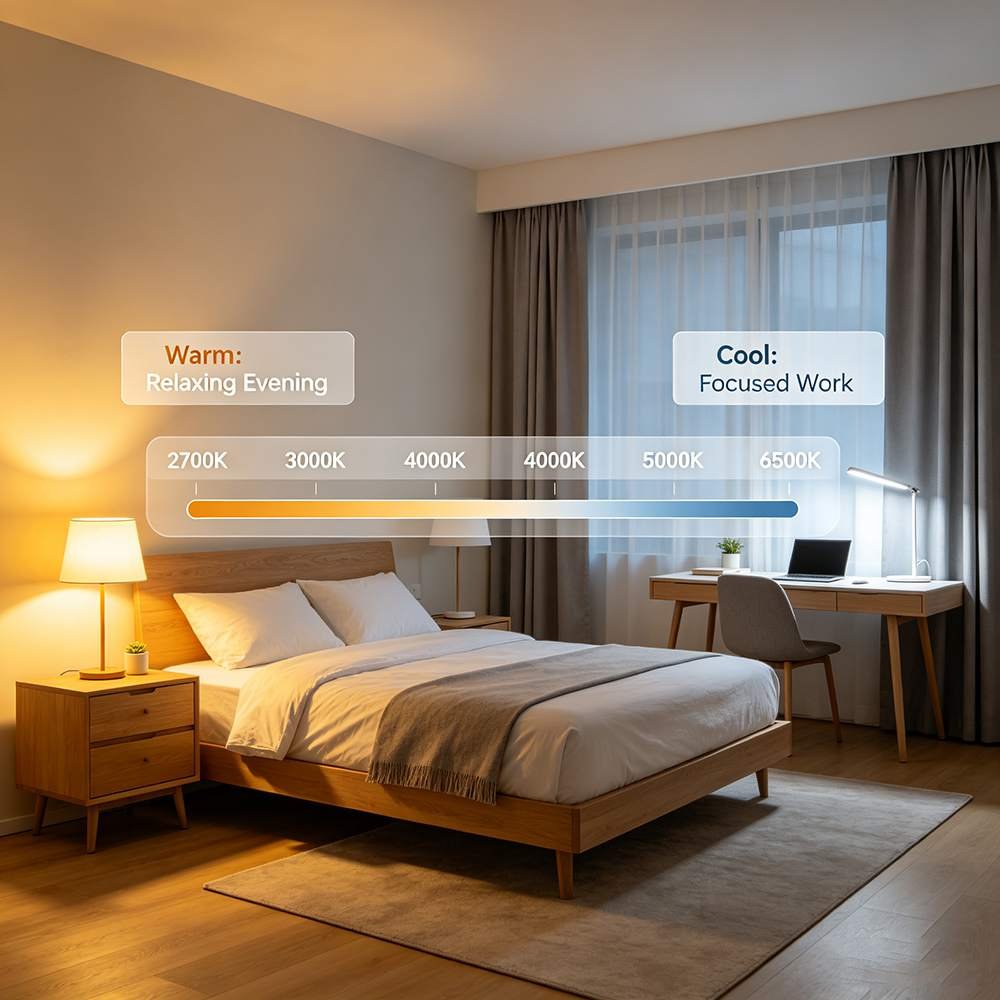
2700K–3000K: warm and comfortable
3500K–4000K: neutral and balanced
5000K–6500K: cool and daylight-like
The mistake is assuming that one range is universally better than another.
A 3000K LED light can be perfect for a hotel lobby but inappropriate for a precision inspection workstation. A 5000K fixture may work well in a workshop but feel unnecessarily cold in a bedroom.
The correct question is not:
“Which color temperature is best?”
It is:
“What do people need to do in this space, and how should the space feel?”
When Should You Choose 2700K LED Lighting?
2700K is one of the warmest commonly used color temperatures for general LED lighting.
It produces a soft, yellowish-white appearance similar to traditional incandescent lighting.
This makes it particularly suitable for spaces where atmosphere and relaxation are important.
Bedrooms
Bedrooms generally benefit from warm lighting.
A 2700K LED wall light, table lamp, bedside lamp, or ceiling fixture can create a comfortable environment for relaxing in the evening.
If the primary purpose is reading, you may want a slightly brighter task light in addition to the warm ambient lighting.
Living Rooms
For living rooms, 2700K works particularly well with:
- Natural wood
- Beige walls
- Warm fabrics
- Brown furniture
- Traditional interiors
- Soft decorative finishes
Warm light tends to enhance reds, oranges, yellows, and wood tones.
Restaurants and Hospitality
Warm lighting is also common in restaurants, cafés, hotels, lounges, and other hospitality environments.
The goal is not simply to illuminate tables. Lighting is part of the customer experience.
A 2700K LED lighting system can make a dining environment feel more intimate and relaxed.
GlowbackLED, for example, describes 2700K as a traditional warm-white choice and notes its popularity in restaurants and hospitality applications.
When Should You Choose 3000K LED Lighting?
If 2700K feels too yellow but 4000K feels too neutral, 3000K is often an excellent compromise.
This is one reason 3000K has become a popular choice for modern residential and architectural lighting.
It still feels warm, but the white light is cleaner and less amber than 2700K.
Residential Interiors
3000K works well in:
- Living rooms
- Bedrooms
- Dining rooms
- Hallways
- Entryways
- Kitchens
- Bathrooms
It is particularly useful when a home combines warm decorative elements with a more contemporary interior.
For example, a modern kitchen with white cabinets and natural oak may look balanced under 3000K without becoming excessively yellow.
LED Wall Lights
3000K is also a strong choice for many LED wall light applications.
A wall light often serves both functional and decorative purposes. A very cool 5000K source can make a decorative wall fixture feel overly commercial, while 2700K may be too warm for some modern interiors.
3000K provides a middle ground that works well for architectural wall lighting, bedroom sconces, corridors, hotels, and residential accent lighting.
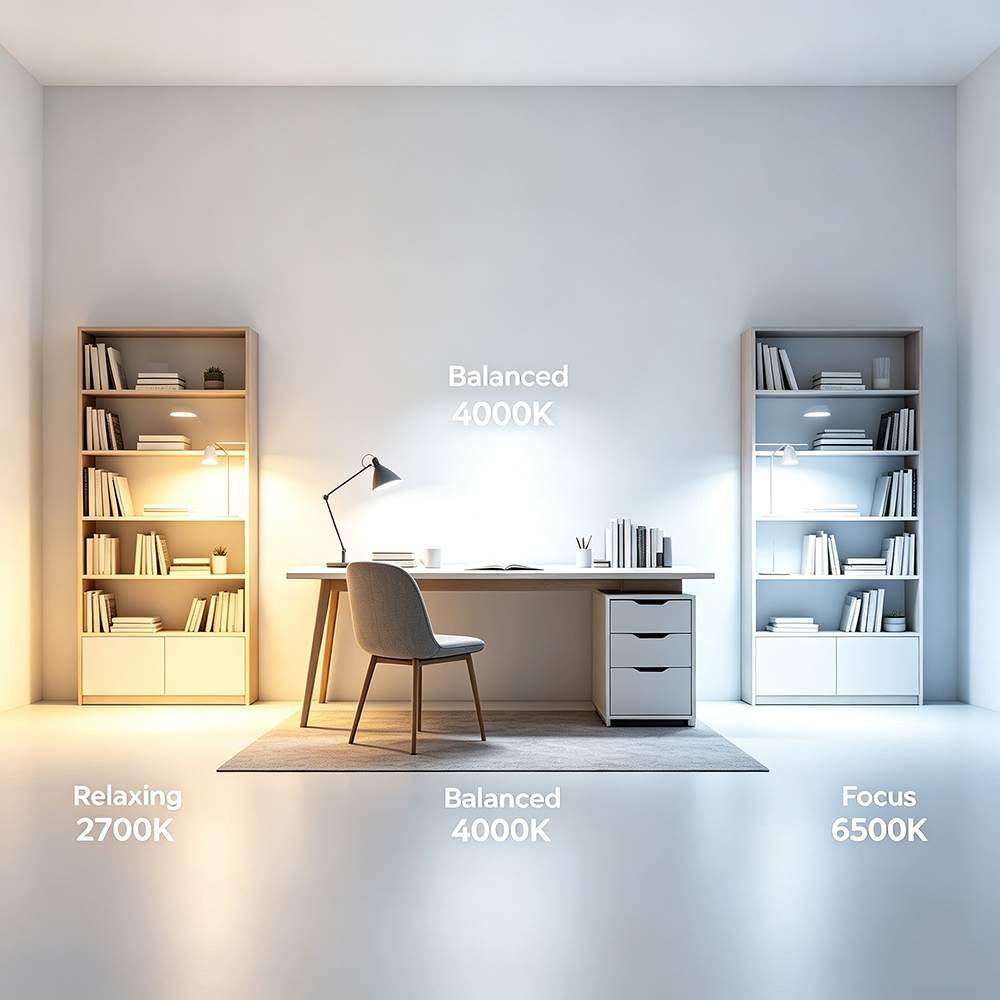
When Should You Choose 3500K–4000K?
If warm white is about atmosphere, 4000K is more about clarity and neutrality.
This range is particularly useful when people need to see colors, surfaces, products, and details clearly while maintaining a relatively comfortable environment.
Kitchens
Kitchens are a good example.
A kitchen isn’t only a place to relax. People prepare food, read labels, clean surfaces, and work with knives and other tools.
For general kitchen lighting, 3500K–4000K can provide a useful balance between warmth and visibility.
For under-cabinet lighting, matching the color temperature of the main kitchen lighting can also make the entire space look more consistent.
LED Light Expert recommends approximately 3500K–4000K for kitchens and notes that under-cabinet task lighting should generally match the surrounding lighting when a consistent appearance is desired.
Bathrooms
4000K is another popular option for bathrooms.
Neutral white light can work particularly well around mirrors because it provides a relatively clean representation of skin tones and bathroom surfaces.
For residential bathrooms, 3500K can provide a softer appearance, while 4000K is useful when a brighter, cleaner appearance is preferred.
Offices
4000K is widely used for office environments.
It provides enough visual clarity for computer work, reading, meetings, and general tasks without the distinctly blue appearance that can occur with very high color temperatures.
For offices with a relaxed brand identity, 3500K can also be considered.
When Should You Choose 5000K–6500K?
Now we move into cooler LED lighting.
5000K and above produces a more daylight-like appearance.
This can be useful when visibility and visual clarity are more important than creating a cozy atmosphere.
Typical applications include:
- Workshops
- Garages
- Warehouses
- Industrial facilities
- Inspection areas
- Utility rooms
- Certain retail environments
- Schools
- Specialized workspaces
For example, a mechanic working in a garage may prefer 5000K because it provides a crisp appearance that makes it easier to see tools, labels, surfaces, and mechanical components.
A warehouse may also use 5000K or higher LED lighting to provide a bright, daylight-like environment.
However, cooler does not automatically mean better.
Putting 6500K LED lighting throughout a restaurant or bedroom could create an unnecessarily harsh atmosphere.
LED Light Expert recommends higher color temperatures for warehouses, inspection and sports applications where visual clarity is a priority.
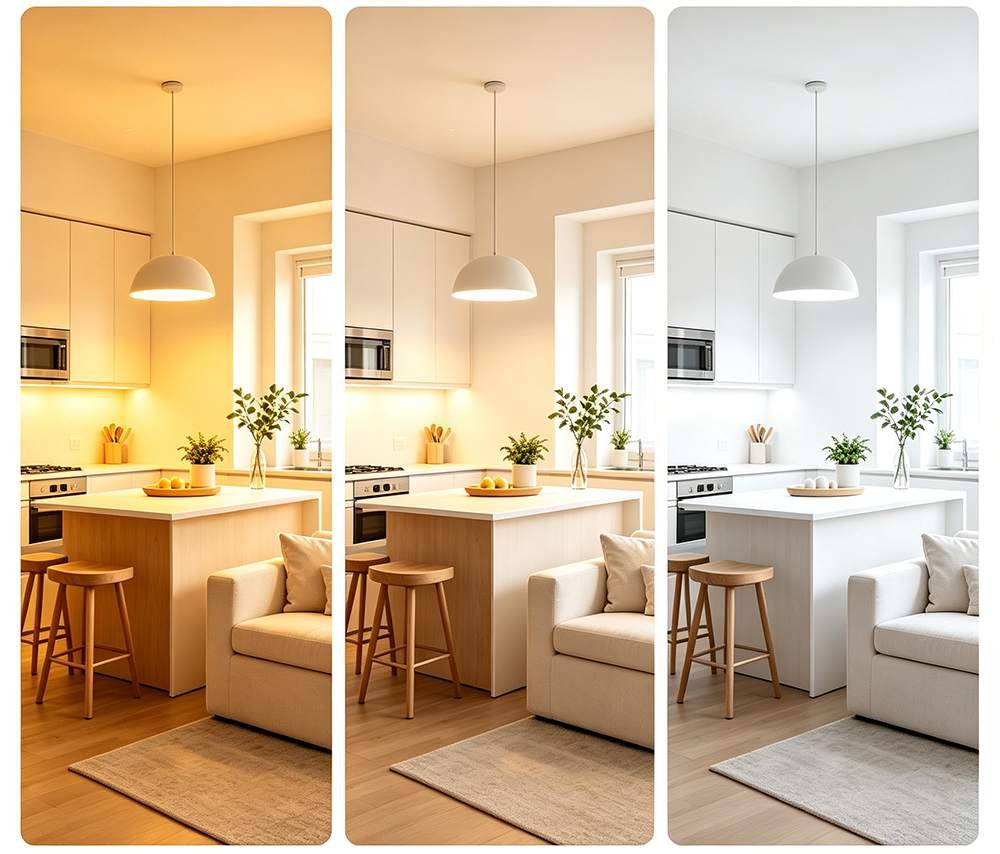
Color Temperature Does Not Determine Brightness
This is one of the most common misunderstandings when selecting LED lighting.
A higher Kelvin value does not mean that the light produces more lumens.
For example:
3000K, 1,000 lumens
and
5000K, 1,000 lumens
can theoretically produce the same amount of light output.
The difference is the color of that light.
GlowbackLED explicitly points out that color temperature does not correlate directly with light intensity.
If you want to compare brightness, look at lumens.
If you want to compare energy consumption, look at watts.
If you want to compare the appearance of white light, look at Kelvin.
These specifications answer different questions.
Color Temperature and CRI Should Be Considered Together
Choosing the right Kelvin value is only part of the lighting equation.
You should also consider CRI, or Color Rendering Index.
CRI indicates how accurately a light source reveals colors compared with a reference light source.
A high-CRI LED lighting product can make materials, products, food, skin tones, artwork, and merchandise appear more natural.
This becomes especially important in:
- Retail stores
- Jewelry shops
- Art galleries
- Restaurants
- Kitchens
- Fashion stores
- Product photography
- Showrooms
For general applications, CRI 80+ may be sufficient. For color-critical applications, CRI 90+ is often preferable.
In other words:
3000K tells you what kind of white the light looks like.
CRI tells you how accurately colors appear under that light.
You need to consider both.
Consider the Interior Materials Before Choosing Color Temperature
The same LED lighting product can look very different depending on the materials and colors surrounding it.
Warm color temperatures tend to emphasize:
- Wood
- Beige
- Cream
- Brown
- Orange
- Red
Cooler light can make:
- White
- Gray
- Blue
- Green
appear cleaner or more pronounced.
GlowbackLED notes that warmer light can enhance warm hues while cooler color temperatures can complement cooler colors.
Therefore, don’t select an LED lighting product by looking only at the Kelvin number.
Look at the entire environment.
For example, a 3000K light may be excellent for a walnut dining table, while a 4000K light may work better in a modern kitchen dominated by white cabinets, gray surfaces, and stainless steel.
What About Spaces With Natural Daylight?
Natural daylight can make color temperature selection more complicated.
A room with large windows may receive significant amounts of daylight during the day but rely entirely on artificial lighting at night.
If the artificial lighting is dramatically warmer or cooler than the daylight, the transition can be visually noticeable.
For spaces with strong natural daylight, 3500K–4000K is often a useful starting point for general LED lighting.
However, the right choice depends on the architecture, interior materials, window orientation, and desired atmosphere.
The important thing is to evaluate the space under both daylight and artificial lighting rather than making the decision based only on a showroom sample.
Should You Use the Same Color Temperature Throughout a Space?
In most cases, consistency is more important than chasing the “perfect” Kelvin number.
Imagine a living room with:
- 2700K floor lamp
- 3000K ceiling light
- 4000K wall light
- 5000K cabinet light
Every individual fixture might be a good product, but together they could create a visually confusing environment.
LED Light Expert recommends keeping a consistent CCT within a space unless a tunable system is deliberately being used to create different lighting scenes.
This is particularly important for commercial environments.
If a retailer uses different color temperatures throughout the same showroom, products may appear different depending on where they are displayed.
For B2B projects, specifying the same CCT, CRI, LED binning and product series can help maintain a consistent appearance.
What If You Need Different Color Temperatures During the Day?
In some environments, a fixed color temperature isn’t ideal.
This is where tunable white LED lighting becomes useful.
A tunable system can allow users to adjust the CCT according to the time of day or activity.
For example:
Morning: 4000K for a more energetic working environment.
Afternoon: 3500K for balanced general lighting.
Evening: 3000K for a softer atmosphere.
This approach can be particularly useful in:
- Hotels
- Restaurants
- Offices
- Healthcare environments
- High-end residential projects
- Hospitality spaces
- Smart buildings
GlowbackLED, for example, offers tunable-white LED strips and control systems that allow the color temperature to be adjusted rather than locked to a single CCT.
For manufacturers, tunable CCT products can also reduce the need to create multiple fixed-CCT SKUs for the same product family.
Don't Forget Dimming
Dimming is another useful feature when choosing an LED lighting product.
A fixed 3000K light at 100% brightness may feel appropriate during dinner preparation but unnecessarily bright later in the evening.
A dimmable fixture gives users more control.
However, standard dimming does not necessarily mean the actual CCT changes. The light simply becomes less intense.
A more advanced option is dim-to-warm technology.
For example, a fixture might operate around 3000K at full brightness and become warmer as it is dimmed, creating a candle-like atmosphere.
This can be particularly attractive for:
- Restaurants
- Hotels
- Living rooms
- Bedrooms
- Decorative LED wall lights
- Hospitality projects
Common Mistakes When Choosing LED Lighting Color Temperature
There are several mistakes that buyers repeatedly make.
Choosing by Kelvin Alone
A 4000K product isn’t automatically better than a 3000K product.
The application determines what is appropriate.
Using 5000K Everywhere
Cool white can be excellent for industrial applications, but excessive use in residential or hospitality spaces can make the environment feel cold.
Mixing Too Many CCTs
Different color temperatures in the same visual field can make an installation look inconsistent.
Ignoring CRI
Two 3000K products can still render colors differently.
Ignoring Existing Lighting
If you’re replacing only part of an installation, the new LED lighting should generally match the existing CCT unless you’re deliberately redesigning the lighting scheme.
Choosing Before Seeing a Sample
Product photos on a website are not always an accurate representation of how a particular CCT will look in your environment.
Whenever possible, test samples in the actual space.
A Simple LED Lighting Color Temperature Selection Guide
If you need a quick starting point, use this:
Application | Recommended CCT |
Bedroom | 2700K–3000K |
Living room | 2700K–3000K |
Dining room | 2700K–3000K |
Restaurant | 2700K–3000K |
Hotel lobby | 2700K–3500K |
Kitchen | 3500K–4000K |
Bathroom | 3500K–4000K |
Office | 3500K–4000K |
Retail | 3000K–4000K |
Jewelry / product display | 3500K–4500K |
Garage | 4000K–5000K |
Workshop | 4000K–5000K |
Warehouse | 4000K–5000K+ |
Inspection area | 5000K–6500K |
Sports facility | 5000K–5700K |
These ranges should be treated as starting points rather than strict rules. The appropriate CCT can change depending on architecture, materials, daylight, brand identity, task requirements, and customer preference.
How to Choose the Right LED Lighting Color Temperature: A 5-Step Method
If you’re selecting products for a residential or commercial project, this simple process can make the decision easier.
Step 1: Define the Purpose
Ask what people will actually do in the space.
Relax?
Cook?
Read?
Work?
Shop?
Inspect products?
The answer should influence the CCT.
Step 2: Look at the Interior
Check the flooring, walls, furniture, cabinets, countertops and other materials.
Warm interiors usually pair naturally with warm lighting, while modern white and gray interiors can tolerate more neutral CCTs.
Step 3: Choose a CCT Range
Start with:
2700–3000K for comfort
3500–4000K for balanced functionality
5000K+ for demanding visual tasks
Then narrow the selection.
Step 4: Check CRI and Lumens
Don’t stop at Kelvin.
Check the CRI and lumen output to make sure the LED lighting product can actually perform the required task.
Step 5: Test Before Mass Installation
This is especially important for B2B projects.
Order samples and test them in the actual environment.
Look at the lighting during both daytime and nighttime. Check how products, walls, furniture and people’s skin tones appear.
Once the right CCT is confirmed, standardize the specification across the project.
Final Thoughts
Choosing the right color temperature is not simply a matter of deciding whether you prefer “warm” or “cool” light.
The right LED lighting color temperature should support the function of the space, complement the interior design, reveal colors appropriately, and create the atmosphere you want.
As a general rule:
2700K–3000K is a strong choice for relaxing and hospitality environments.
3500K–4000K works well for kitchens, bathrooms, offices and general commercial spaces.
5000K–6500K is more suitable for industrial, inspection and other applications where crisp, daylight-like illumination is useful.
But Kelvin is only one part of the specification. CRI, lumens, optics, glare, dimming, existing lighting and consistency across the installation can all affect the final result.
For led lighting manufacturers, distributors and project buyers, offering multiple CCT options—or even tunable-white solutions—can therefore make an LED lighting product much more versatile.
The best approach is simple: choose the color temperature based on the space, not just the number printed on the product box.