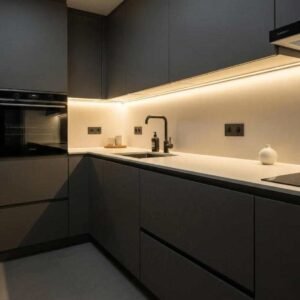

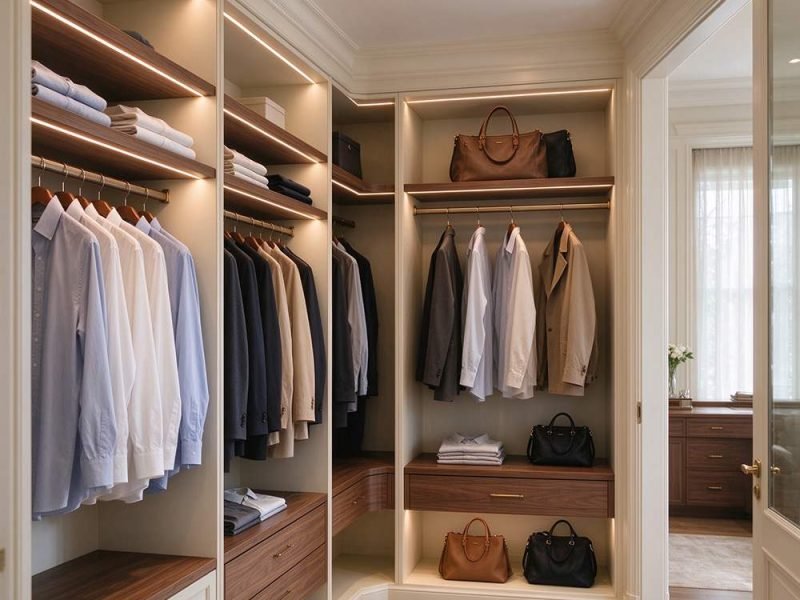
A well-organized closet makes it easier to find clothes, shoes, bags, and accessories, but even the most carefully designed storage space can feel inconvenient when the shelves are poorly lit. Dark corners, deep shelves, and shadows between stacked clothes often make it difficult to see what is stored inside. Choosing the right LED light for closet shelves can solve these problems while making a closet look cleaner, more modern, and easier to use.
Today, closet lighting is available in many forms, including rechargeable LED light bars, motion-sensor lights, LED strip lights, puck lights, and integrated shelf lighting systems. Each option offers different advantages depending on the shelf layout, available power supply, installation requirements, and desired appearance.
This guide explores practical closet shelves LED light ideas, explains how to choose the best lighting solution, and highlights important factors to consider before installation.
Why Add LED Lighting to Closet Shelves?
Closet shelves are often positioned in areas where general room lighting cannot provide enough illumination. A ceiling light may brighten the center of a walk-in closet while leaving the upper shelves, lower compartments, and corners relatively dark.
Adding dedicated shelf lighting offers several benefits.
Better visibility: LED lights illuminate individual shelves, making it easier to distinguish dark-colored clothing, identify accessories, and locate small items without moving everything around.
More convenient access: Lighting helps users find what they need quickly, particularly in deep closets or storage compartments that are difficult to reach.
A cleaner appearance: Well-planned lighting can make a closet feel more organized. Linear lighting creates a neat, continuous appearance, while small puck lights can provide focused illumination for individual display areas.
Energy-efficient operation: LEDs generally consume less electricity than traditional incandescent lighting and are available in low-voltage and rechargeable configurations. Their actual energy consumption depends on the product’s wattage, brightness, and operating time.
Flexible design: LED lighting can be installed in existing closets or incorporated into new cabinetry. Options include surface-mounted fixtures, recessed channels, adhesive-backed lights, and concealed lighting systems.
7 LED Light Ideas for Closet Shelves Worth Considering
The best lighting arrangement depends on whether your priority is simple installation, automatic operation, decorative effects, or a permanent built-in appearance.
1. LED Strip Lights Under Each Shelf
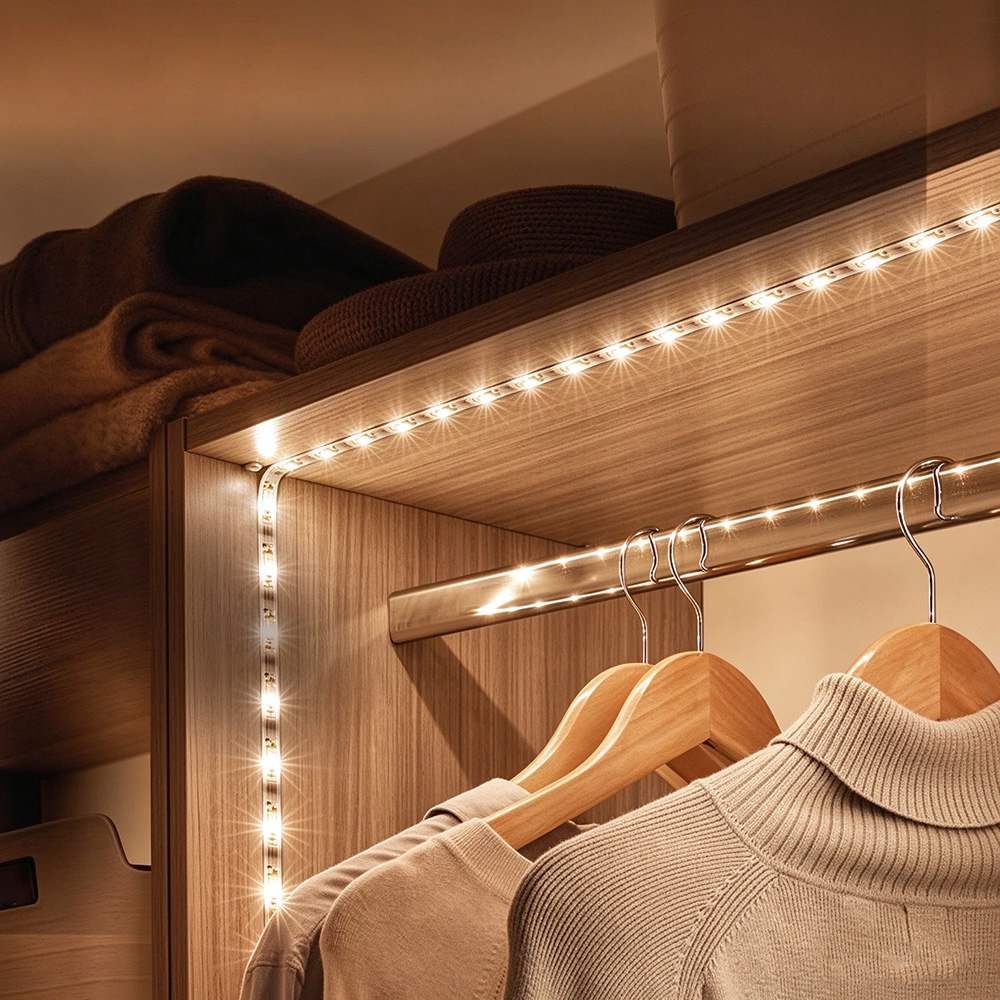
LED strip lights are one of the most versatile options for closet shelf lighting. A strip installed beneath a shelf can illuminate the clothing, accessories, or storage boxes directly below it.
For a clean appearance, the strip can be placed near the front edge of the shelf or slightly behind the front edge to reduce direct glare. If the strip is installed inside an aluminum LED channel with a suitable diffuser, the result can look more integrated and help protect the strip from physical damage.
This solution works particularly well for long shelves, open wardrobes, and walk-in closets with multiple horizontal storage levels.
Best for: Long shelves, built-in wardrobes, and continuous linear lighting.
Advantages: Flexible lengths, relatively uniform illumination, and many brightness and color-temperature options.
Things to consider: Wired strips may require a suitable power supply, careful cable routing, and accessible connections. For a professional-looking installation, the LED strip, channel, diffuser, and power supply should be selected as a compatible system.
2. Rechargeable LED Light Bars
Rechargeable LED light bars are a practical choice when you want to add lighting without rewiring the closet. These slim fixtures can often be mounted underneath shelves, inside cabinet compartments, or along the sides of a wardrobe.
Many models use magnetic mounting plates or adhesive brackets, allowing the light to be removed for charging. Depending on the product, controls may include a physical button, touch control, dimming, or remote operation.
Rechargeable lights are especially useful for renters and people upgrading an existing closet without undertaking a renovation.
Best for: Existing closets, rental homes, and DIY upgrades.
Advantages: No permanent wiring, flexible placement, and straightforward installation.
Things to consider: Battery capacity, charging frequency, brightness, and the availability of replacement batteries can affect long-term convenience. Check the manufacturer’s stated runtime and remember that higher brightness and frequent activation may shorten the time between charges.
3. Motion-Sensor LED Lights
Motion-sensor lighting is an excellent option for closets that are opened and used frequently throughout the day. Depending on the design, a sensor may detect movement nearby or respond when a door opens.
When movement is detected, the light turns on automatically. It switches off after a preset period without activity, helping reduce unnecessary operation.
Motion-sensor LED lights are particularly useful for deep shelves, linen closets, wardrobe compartments, and storage areas where users may have their hands full.
Some products use passive infrared (PIR) sensors, while others use door sensors or different detection technologies. These systems do not all work in the same way, so the sensing method should match the intended installation.
Best for: Frequently accessed closets and hands-free lighting.
Advantages: Convenient automatic operation and less need to locate a switch.
Things to consider: Sensor range, detection angle, delay settings, and the possibility of false activation matter. For enclosed compartments, a door-activated light may be more predictable than a motion sensor positioned where movement is difficult to detect.
4. LED Puck Lights for Individual Shelves
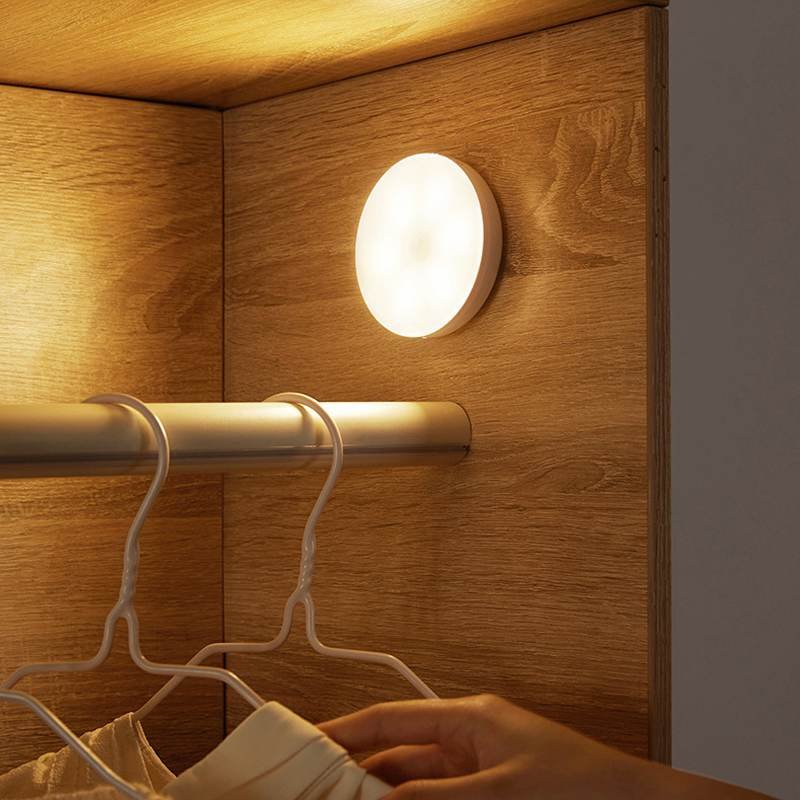
LED puck lights are small, round fixtures that provide focused illumination. They can be installed beneath shelves, above display compartments, or near selected storage areas.
Unlike a continuous strip, puck lights create separate pools of light. This can be useful when a closet contains several distinct sections, such as handbag displays, shoe shelves, jewelry storage, or decorative accessories.
Battery-operated puck lights are easy to add to existing furniture, while wired models may be suitable for more permanent installations.
Best for: Small compartments, display shelves, and accent lighting.
Advantages: Compact size, flexible positioning, and a simple way to highlight selected objects.
Things to consider: Spacing is important. If puck lights are placed too far apart, bright spots and dark areas may appear between them. They may also create stronger shadows than a well-designed linear light.
5. Recessed LED Shelf Lighting
For a new closet or a major wardrobe renovation, recessed lighting can create a more integrated appearance. LED strips or compact linear fixtures are installed in routed grooves or dedicated channels within the shelving structure.
Because the light source sits within the shelf, the fixture can be less noticeable than a surface-mounted product. This is particularly attractive in modern wardrobes with clean lines and minimal visible hardware.
Recessed lighting can also be designed around the shelf’s dimensions, allowing the lighting system to align with the cabinetry.
Best for: Custom wardrobes, premium closets, and new cabinetry projects.
Advantages: A built-in appearance, concealed installation, and potential for consistent lighting across multiple shelves.
Things to consider: Installation needs to be planned before the shelves are manufactured or finished. The channel dimensions, wiring route, driver location, ventilation, and access for maintenance should all be considered.
6. Side-Mounted Vertical LED Lighting
Although lighting directly beneath shelves is common, vertical lighting along the sides of a closet can be equally useful. A vertical LED strip or light bar illuminates several shelf levels at once, reducing the need to install a separate fixture under every shelf.
This approach can work particularly well in narrow wardrobe compartments, closets with adjustable shelving, and cabinets where horizontal lights might be obstructed by stored items.
Side-mounted lighting can also complement under-shelf lighting when the closet contains deep compartments.
Best for: Tall storage units, adjustable shelves, and narrow wardrobe sections.
Advantages: Can illuminate several levels, creates a modern visual effect, and may simplify installation in certain layouts.
Things to consider: The light must reach the back of the shelves without creating uncomfortable glare. Positioning the fixture too far forward may make the light source visible whenever the closet is opened.
7. Smart LED Closet Shelf Lighting
Smart LED lighting adds control options to conventional shelf illumination. Depending on the product, users may be able to adjust brightness, change color temperature, schedule operating times, or control the lights through an app, remote, or compatible smart-home system.
For most closets, adjustable white light is more useful than extensive RGB color effects. Warm white can create a relaxed atmosphere, while neutral or cool white can help make clothing colors easier to distinguish.
Smart control is particularly valuable in large walk-in closets with several lighting zones. Different shelves or wardrobe sections can be controlled independently, making it easier to use only the lights needed.
Best for: Large walk-in closets, connected homes, and customized wardrobe systems.
Advantages: Flexible control, dimming options, and the possibility of coordinating multiple fixtures.
Things to consider: Confirm whether the product requires Wi-Fi, Bluetooth, a hub, or a specific app. Also check whether the system retains its settings after a power interruption and whether its controls remain usable if the network is unavailable.
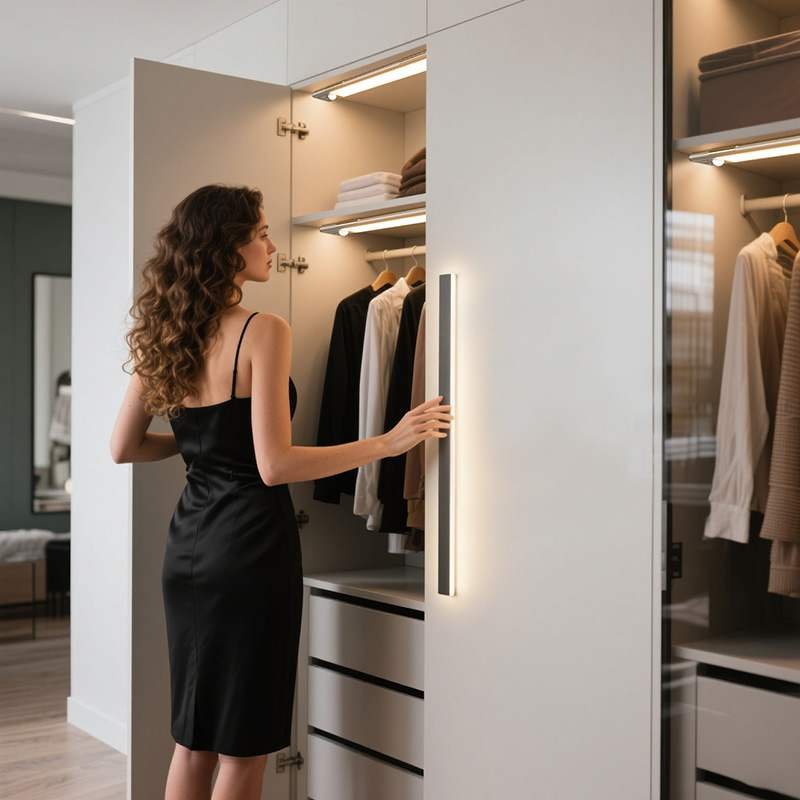
How to Choose the Best LED Light for Closet Shelves
Before choosing a fixture, evaluate the shelf dimensions, the type of items stored, and how the closet is used. A suitable product should provide enough useful light without making installation or maintenance unnecessarily complicated.
1. Choose the Right Brightness
Brightness is measured in lumens. Wattage describes power consumption, not directly how bright a light will appear.
Small compartments containing accessories may need only modest illumination, while deep shelves, dark finishes, and large wardrobe sections may require brighter or more carefully distributed lighting.
Rather than choosing a product based on wattage alone, consider the lit area, mounting position, and whether the light reaches the back of the shelf. A diffuser and well-positioned linear fixture can often provide a more comfortable result than a very bright point source.
2. Select a Suitable Color Temperature
Color temperature is measured in kelvins (K).
Color temperature | Appearance | Suitable applications |
2700K–3000K | Warm white | Cozy closets, bedrooms, decorative shelving |
3500K–4000K | Neutral white | Everyday wardrobe lighting and general storage |
5000K–6500K | Cool white to daylight-like | Utility storage and users who prefer a cooler appearance |
For most residential closets, 3000K–4000K is a useful starting range. If matching clothing colors is important, also check the color rendering index (CRI). A CRI of 90 or higher is worth considering when accurate color appearance is a priority.
3. Decide Between Wired and Rechargeable Lighting
Wired LED lighting is generally more suitable for permanent installations, especially when many shelves need consistent illumination. It avoids routine battery charging, although the power supply and wiring must be installed correctly.
Rechargeable lights are often easier to install in existing closets. They can be especially convenient when only one or two shelves need additional illumination.
Consider the total number of fixtures before deciding. A single rechargeable light may be simple to maintain, but charging several lights throughout a large wardrobe can become inconvenient.
4. Check Installation and Mounting Options
Closet shelf lights may use adhesive pads, screws, magnetic brackets, surface-mounted clips, or recessed channels. The right option depends on the shelf material, fixture weight, and whether the installation needs to be removable.
Adhesive mounting is convenient, but the surface should be clean, dry, and compatible with the adhesive. Heavy fixtures or permanent installations may require mechanical fasteners.
For wired products, plan where cables will run and where the driver or power supply will be located. Keep connections accessible for inspection and future replacement.
5. Consider Sensor Performance and Controls
If automatic operation is important, check how the sensor works and where it should be installed. A sensor that performs well in an open wardrobe may behave differently inside a deep or enclosed compartment.
Also consider whether you need manual override, adjustable shutoff time, dimming, or remote control. These details can make a bigger difference in daily convenience than additional lighting effects.
6. Look at Heat Management and Product Quality
LEDs are efficient, but the fixture still produces heat. In a permanent strip-light installation, a suitable aluminum channel can help conduct heat away from the LED strip and provide a finished mounting surface.
Check the manufacturer’s installation instructions, operating temperature limits, power requirements, and any applicable safety certifications. Avoid placing fixtures where clothing can cover them or where heat cannot dissipate as intended.
For closets exposed to humidity, choose a product with an appropriate protection rating for the actual environment. A waterproof fixture is not automatically necessary for a normal dry bedroom closet.
Common Mistakes to Avoid
Even a good LED product can produce poor results when installed incorrectly.
- Installing lights too far behind the shelf edge:Stored objects may block the light, leaving the front of the shelf dark.
- Using only decorative accent lighting:A visually attractive fixture may not provide enough illumination for everyday storage tasks.
- Choosing a color temperature without considering the room:Very cool lighting may look harsh in a warm, residential bedroom.
- Ignoring charging and maintenance:Rechargeable lights need convenient access for charging, while wired systems should allow access to drivers and connections.
- Overlooking glare:Exposed LEDs can be uncomfortable when viewed directly. A diffuser or concealed mounting position may improve visual comfort.
- Using incompatible power components:Voltage, current, wattage, connectors, and dimming compatibility should be checked before connecting LED strips, drivers, or controls.
Final Thoughts
The best LED light for closet shelves depends on your storage layout, installation preferences, and lighting goals. LED strip lights are ideal for continuous illumination across long shelves, rechargeable light bars are convenient for simple upgrades, and motion-sensor lights make everyday access easier. Puck lights work well for individual compartments, while recessed and smart lighting systems suit more customized wardrobe designs.
For most existing closets, a rechargeable LED light bar or a well-positioned motion-sensor fixture is a practical starting point. For a new built-in wardrobe, integrated LED strip lighting with a suitable aluminum channel and diffuser can deliver a cleaner, more consistent result.
Before purchasing, compare brightness, color temperature, power options, mounting methods, sensor behavior, and maintenance requirements. A well-planned closet shelves LED light setup should do more than make the closet look attractive: it should help you find what you need comfortably and reliably every day.