
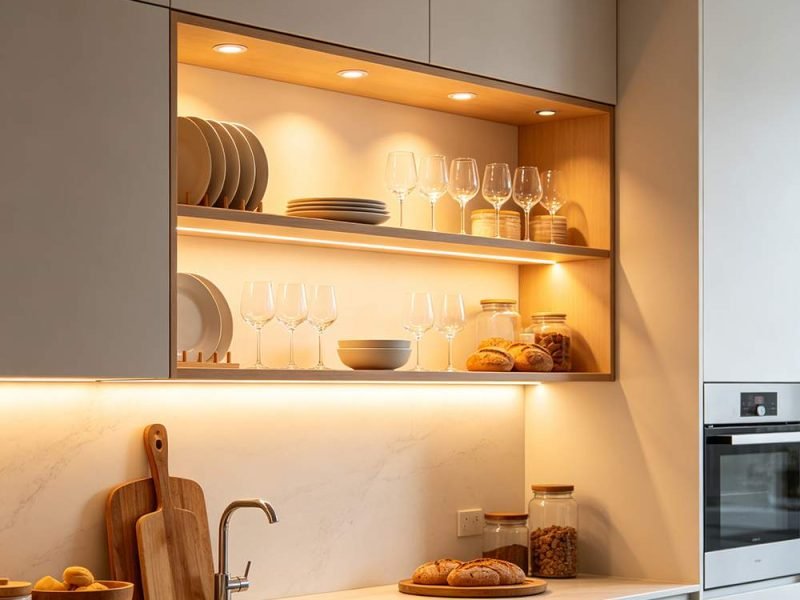
Good cabinet lighting can completely change the appearance and functionality of a kitchen, wardrobe, bookshelf, display cabinet, or bathroom cabinet. It can make a countertop easier to use, highlight products inside a display cabinet, improve visibility in a wardrobe, or simply create a warm layer of ambient lighting.
However, choosing the best cabinet lighting is not simply about buying the brightest LED light. Different applications require different lighting types, power supplies, installation methods, color temperatures, and control systems.
Current product testing from publications such as The Spruce and Better Homes & Gardens shows that cabinet lighting now includes LED bars, strip lights, puck lights, rechargeable lights, motion-sensor products, and smart lighting. The most suitable choice depends largely on how the cabinet will be used.
This guide explains the main types of LED cabinet lighting and the factors you should consider before choosing one.
What Is Cabinet Lighting?
Cabinet lighting refers to lighting installed inside, underneath, above, or around cabinets and storage furniture.
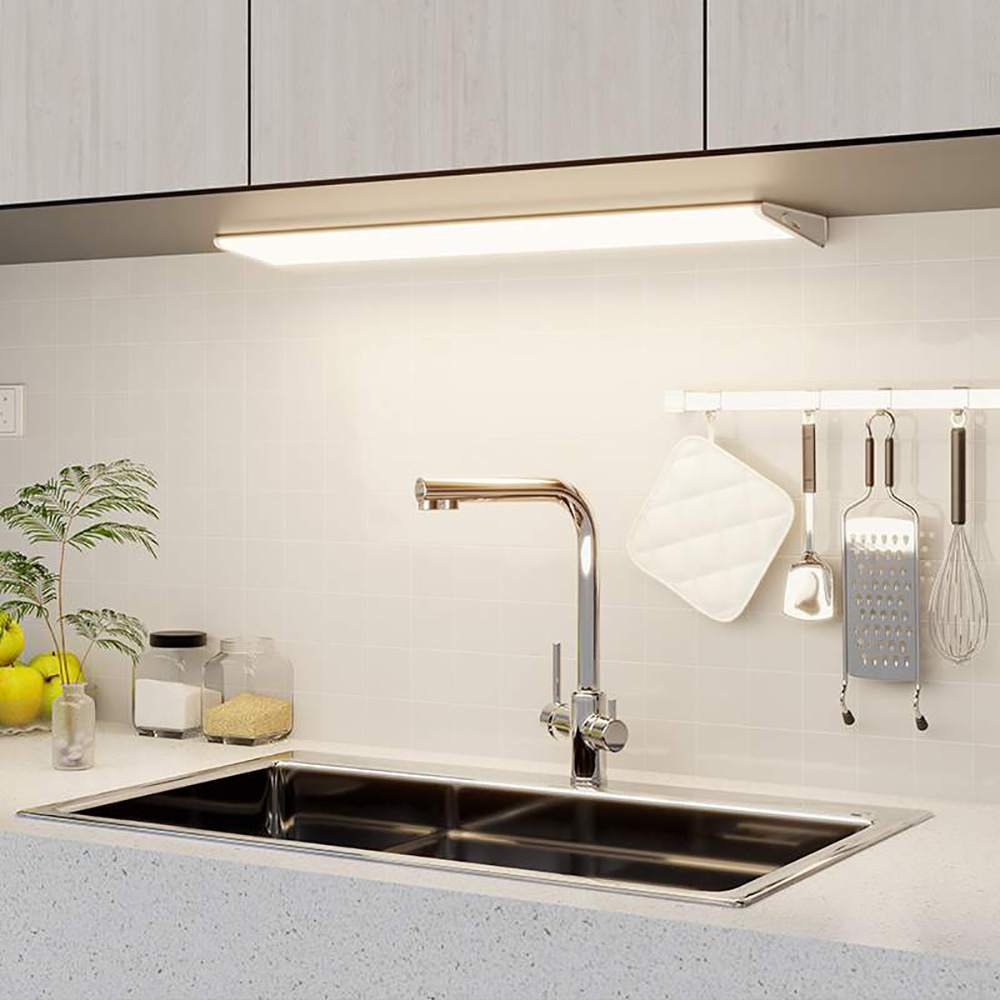
One of the most common applications is under-cabinet lighting in kitchens. These lights illuminate countertops that may otherwise be partially shaded by wall cabinets.
However, cabinet lighting is not limited to kitchens. LED lighting can also be installed in:
- Kitchen cabinets
- Wardrobes
- Bookshelves
- Display cabinets
- Bathroom cabinets
- Wine cabinets
- Retail displays
- Furniture
- Closets and storage areas
Modern LED technology makes cabinet lighting available in many forms, including flexible strips, rigid light bars, puck lights, recessed fixtures, and sensor-controlled rechargeable lights.
The Best Types of LED Cabinet Lighting
There is no single cabinet light that is best for every application. The following options cover most residential and commercial cabinet lighting requirements.
1. LED Strip Lights
LED strip lights are one of the most flexible choices for cabinet lighting.
A strip consists of a flexible PCB with multiple LEDs arranged along its length. Because it can be cut at designated points and installed around corners or along long cabinet runs, it is particularly useful when continuous illumination is required.
The Spruce’s current testing also identifies LED strip lights as an important under-cabinet option because they can be bent and cut to accommodate different installation requirements.
LED strips are especially suitable for long kitchen cabinets because one continuous light source can illuminate a large area without the separate pools of light produced by individual puck lights.
For the best appearance, however, it is often better not to install a bare LED strip directly onto the cabinet surface.
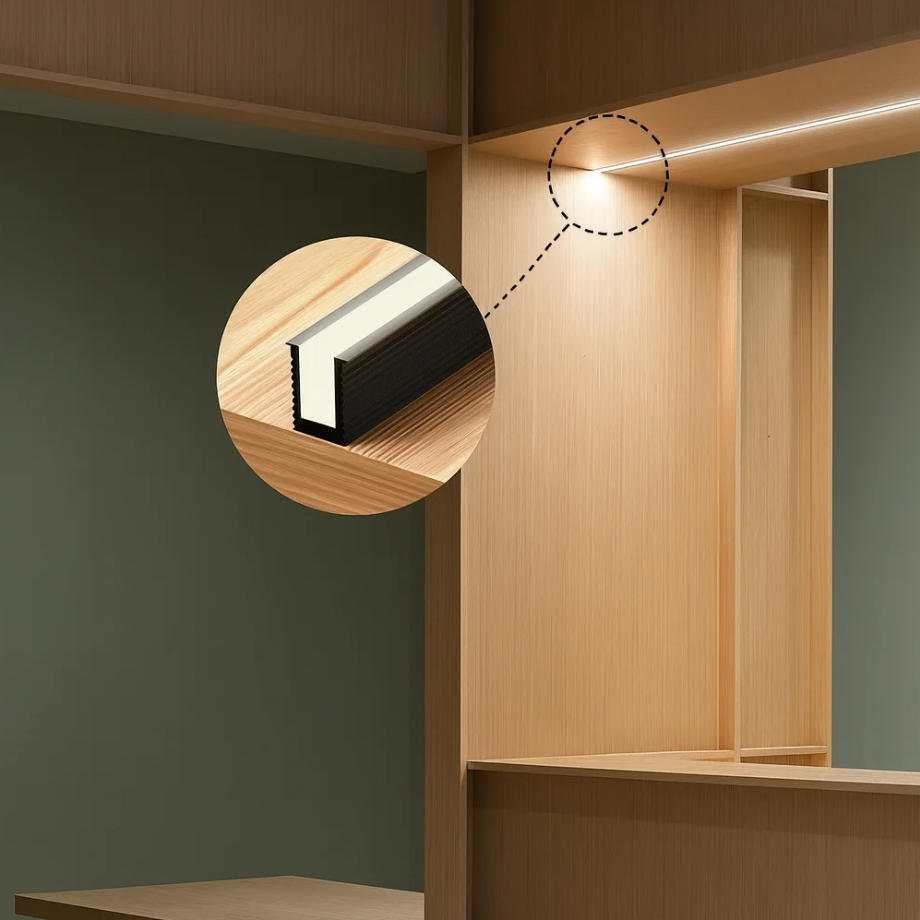
A high-quality aluminum LED channel with a diffuser can provide several benefits. It can protect the strip, improve heat dissipation, soften the light, and reduce the visibility of individual LED points.
This is also reflected in discussions among lighting enthusiasts on Reddit, where users frequently recommend installing LED tape inside an aluminum track with a diffuser rather than leaving the strip exposed.
2. LED Light Bars
LED light bars are another practical cabinet lighting solution.
Unlike flexible strips, LED bars are rigid and usually come in predetermined lengths. They can be mounted underneath kitchen cabinets, inside wardrobes, or along shelves.
Their main advantage is simple installation. Many products are supplied with mounting brackets, adhesive backing, or screws.
The Spruce’s testing of LED cabinet bars highlighted features such as adjustable brightness, tool-free installation, and slim aluminum housings.
Light bars can be a particularly good option when you want a clean, finished product without designing an LED strip system from individual components.
3. LED Puck Lights
Puck lights are small, usually round fixtures that resemble a hockey puck.
Instead of producing one continuous line of light, multiple puck lights create separate pools of illumination.
This can be attractive in some applications. For example, individual light pools can add visual depth to glass cabinets, bookshelves, or display furniture.
BHG’s testing included puck-style cabinet lights as a practical option, particularly for users looking for simple installation and localized task lighting.
However, puck lights may not provide the same continuous countertop illumination as a well-designed LED strip.
As one Reddit discussion illustrates, some users actually prefer these separate pools of light for aesthetic reasons, particularly when they are reflected on dark countertops.
Therefore, choosing between puck and strip lighting is partly a functional decision and partly a design preference.
Hardwired vs. Plug-In vs. Rechargeable Cabinet Lighting
Power supply is one of the most important decisions when choosing cabinet lighting.
Hardwired Cabinet Lighting
Hardwired lighting is connected directly to the home’s electrical system.
This approach generally creates the cleanest finished appearance because there are fewer visible wires or power adapters.
It is particularly suitable for new kitchen construction, major renovations, hotels, custom furniture, and other projects where wiring can be planned before installation.
The disadvantage is that installation is more complicated and normally requires appropriate electrical work.
Plug-In Cabinet Lighting
Plug-in lighting connects to a standard electrical outlet.
It is easier to install than a hardwired system and can be a good solution for existing kitchens or rental properties.
The main disadvantage is cable management. Power cords can become visible underneath cabinets if they are not properly concealed.
This issue also appeared in The Spruce’s testing, where visible power cords were identified as one drawback of some plug-in cabinet lights.
Rechargeable Cabinet Lighting
Rechargeable cabinet lights contain an integrated battery and can be installed without a permanent electrical connection.
They are especially useful for:
- Rental homes
- Wardrobes
- Closets
- Drawers
- Small cabinets
- Areas without nearby outlets
BHG’s testing found rechargeable and motion-sensor products convenient for installation, although battery life and charging time are important considerations. One tested motion-sensor bar required several hours of charging and had considerably shorter continuous operating time than a permanently powered system.
For frequently used kitchen countertops, wired lighting may therefore be more convenient in the long term.
Motion Sensor Cabinet Lighting
Motion sensors have become increasingly popular for cabinet lighting.
A motion sensor can automatically turn the light on when someone approaches and turn it off after a predetermined period.
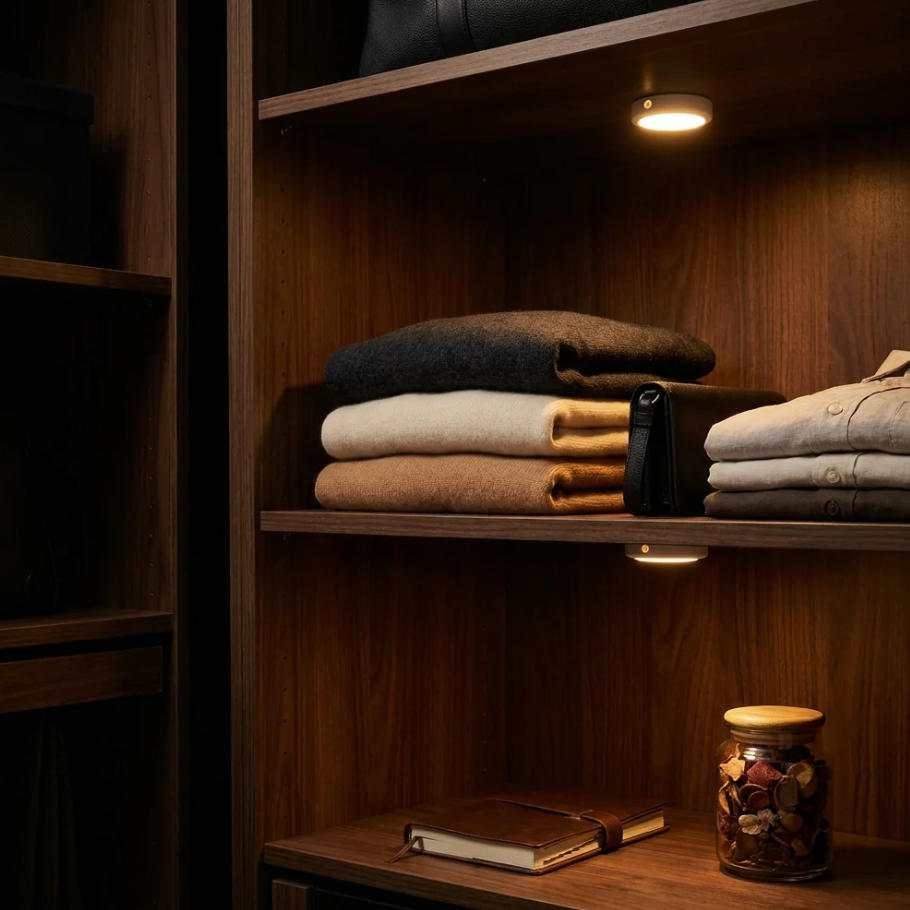
This is particularly useful for wardrobes, closets, kitchen cabinets, and nighttime navigation.
For example, opening a wardrobe door or walking into a dark kitchen can automatically activate the lighting without requiring a wall switch.
BHG’s testing found motion-sensor cabinet lights useful for situations such as getting a drink or snack at night because they provide localized illumination without requiring the full overhead lighting system.
For a cabinet lighting manufacturer, motion control can also be combined with other technologies such as:
- PIR motion sensors
- Microwave sensors
- Door sensors
- Hand-wave sensors
- Touch controls
- Remote controls
The right sensor depends on the application.
What Color Temperature Is Best for Cabinet Lighting?
Color temperature has a major effect on how cabinet lighting looks.
For most residential cabinet applications, the common choices are:
Color Temperature | Appearance | Typical Application |
2700K | Warm white | Bedrooms, decorative cabinets, cozy kitchens |
3000K | Warm-neutral white | Kitchens, wardrobes, living spaces |
4000K | Neutral white | Work areas, kitchens, commercial cabinets |
5000K+ | Cool daylight | Workshops, technical areas, certain commercial applications |
For kitchen cabinet lighting, 3000K to 4000K is often a practical range.
Around 3000K creates a warmer atmosphere while still providing useful task illumination. Around 4000K produces a cleaner, more neutral appearance and can be useful when accurate visibility is important.
If the lighting is primarily decorative, warmer light may be more appropriate.
For a cabinet used to display products, however, CRI can be just as important as color temperature.
Don't Choose Cabinet Lighting Based Only on Brightness
Brightness is another area where buyers often make mistakes.
A very bright light is not automatically a better cabinet light.
For task lighting, you want enough illumination to see the countertop clearly. But excessive brightness can create glare, especially when the countertop is made from polished stone, glass, or another reflective material.
A better approach is to consider the complete lighting system:
Lumens + LED density + installation position + diffuser + beam angle + surface reflectivity
For example, placing a strip near the front edge of a cabinet can direct more light toward the work surface.
Interestingly, this exact issue came up in the Reddit discussion: one experienced commenter recommended positioning tape lighting toward the front of the cabinet rather than at the rear because it can improve task lighting and create a better glow on the backsplash.
Why an Aluminum Channel Can Improve Cabinet Lighting
For professional or high-end cabinet lighting, an LED strip combined with an aluminum channel is often worth considering.
An aluminum profile provides several functions at the same time.
Better heat dissipation
LED strips generate heat, especially when operated at higher power. Aluminum provides a thermal path that can help move heat away from the LED strip.
Better appearance
A diffuser can hide individual LED points and create a smoother luminous line.
This is particularly important on reflective countertops. Individual bright LED points can otherwise produce distracting reflections.
Reddit users discussing under-cabinet lighting specifically mentioned frosted coverings and aluminum channels as ways to achieve a cleaner appearance and reduce visible hotspots.
More protection
The profile can protect the LED strip from physical contact, dust, and certain environmental conditions.
More installation options
Different aluminum profiles can provide:
- Surface mounting
- Recessed mounting
- Corner mounting
- Angled illumination
- Slimline installation
- Flush installation
For cabinet and furniture applications, angled profiles can be particularly useful because they allow light to be directed toward the countertop or inside the cabinet rather than directly into the user’s eyes.
Smart Cabinet Lighting
Smart cabinet lighting is another option for modern homes.
Smart systems can allow users to control:
- Brightness
- Color temperature
- On/off schedules
- Color
- Scenes
- Motion activation
- Voice commands
For example, smart lighting can automatically turn on cabinet lighting in the evening and switch it off at bedtime.
BHG’s testing found app-based smart strip lighting particularly useful for users who want adjustable brightness, color, schedules, and integration with other smart-home products.
However, smart lighting also adds complexity and cost.
If the goal is simply to illuminate a kitchen countertop, a conventional dimmable LED system may be sufficient.
Best Cabinet Lighting for Different Applications
Instead of choosing one product for every situation, consider the application.
Application | Recommended Cabinet Lighting |
Kitchen countertop | LED strip or LED bar |
Long cabinet runs | LED strip + aluminum channel |
Wardrobe | Motion-sensor LED bar or strip |
Glass display cabinet | LED strip or puck lights |
Bookshelf | LED strip |
Kitchen drawers | Rechargeable or sensor LED |
Rental property | Rechargeable or adhesive LED lights |
High-end kitchen renovation | Hardwired LED strip + aluminum profile |
Retail display | High-CRI LED strip or linear light |
Decorative cabinet | Warm-white strip or puck lighting |
What to Look for When Buying Cabinet Lighting
Before purchasing cabinet lighting, consider the following factors.
1. Light quality
Look at brightness, CRI, color temperature, and light uniformity rather than wattage alone.
2. Installation method
Decide whether you want hardwired, plug-in, rechargeable, adhesive, recessed, or surface-mounted installation.
3. Power supply
Check whether the driver or power adapter is included and whether its output matches the lighting system.
4. Heat management
For high-output LED strips and continuously operated lighting, proper thermal management is important.
5. Controls
Consider whether you need a simple switch, dimmer, motion sensor, touch control, remote, or smart-home integration.
6. Diffusion
If the lighting will be visible or reflected on a glossy surface, a diffuser can make a significant difference.
7. Cabinet dimensions
Measure the available space before purchasing. This is particularly important for LED bars and LED strips that have specific cutting or connection requirements.
8. Environment
Kitchen cabinets can be exposed to heat, steam, moisture, and grease. Bathroom and outdoor-adjacent applications may require appropriate ingress protection and materials.
What Is the Best LED Cabinet Lighting?
There is no single product that is the best for every cabinet.
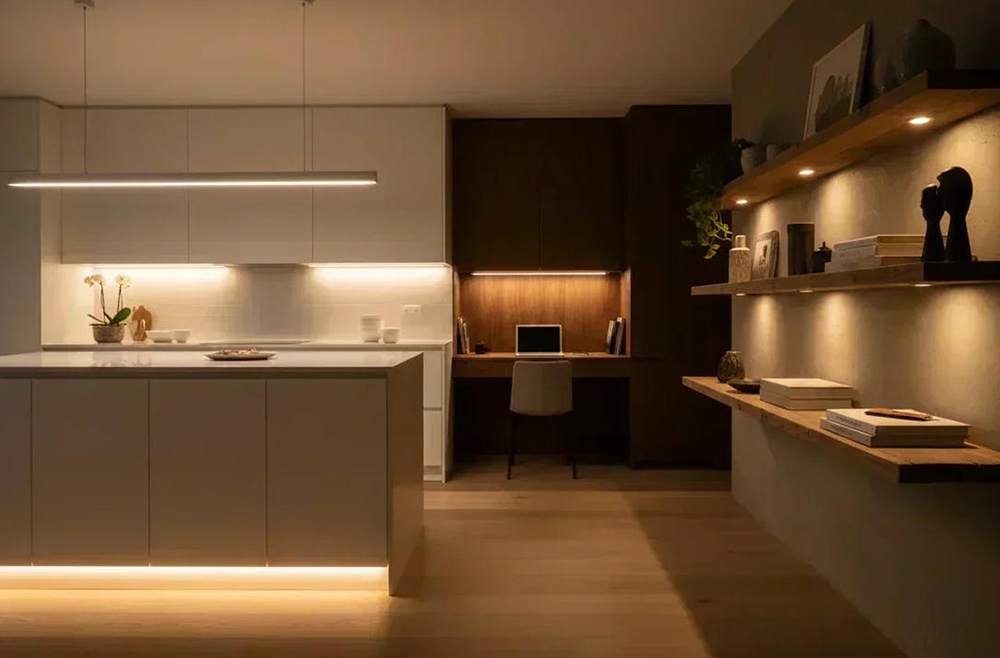
For continuous countertop illumination, LED strip lighting is one of the most flexible choices, particularly when installed inside an aluminum profile with a diffuser.
For simple installation, LED bars are convenient and provide a finished appearance without requiring a complicated strip-lighting system.
For localized pools of light, puck lights can create an attractive alternative to continuous strips.
For wardrobes and closets, motion-sensor rechargeable lights can provide convenient automatic illumination.
For new construction and high-end kitchens, a hardwired LED strip system can provide a cleaner integrated appearance.
For smart homes, app-controlled LED cabinet lighting can add scheduling, dimming, color-temperature adjustment, and automation.
The important point is that the best cabinet lighting is determined by the application rather than the product category alone.
Final Thoughts
The best cabinet lighting should do more than simply make a cabinet brighter. It should provide the right combination of illumination, appearance, convenience, energy efficiency, and installation flexibility.
LED strips are excellent for continuous lighting, LED bars provide a straightforward installation option, and puck lights create individual pools of illumination. Rechargeable and motion-sensor products are particularly useful where wiring is difficult, while hardwired systems are better suited to permanent renovations and professional installations.
For a high-quality result, pay attention to details such as color temperature, CRI, brightness, LED density, diffuser design, aluminum heat dissipation, power supply, sensor type, and installation position.
And if you are designing cabinet lighting for a kitchen or other high-use space, don’t overlook the difference between simply placing an LED strip under a cabinet and designing a complete lighting system. A properly positioned LED strip, combined with an aluminum channel and diffuser, can provide a much more uniform and comfortable result.
Ultimately, the right cabinet lighting should make the space easier to use during the day and more comfortable to experience at night.