
Bathroom vanity lighting plays an important role in both the appearance and functionality of a bathroom. Whether you are applying makeup, shaving, washing your face, or simply getting ready for the day, proper lighting helps you see clearly and perform everyday tasks comfortably.
Traditional incandescent and fluorescent lights have been used in bathrooms for many years. However, as lighting technology has developed, LED lights have become an increasingly popular choice for modern bathroom vanity areas.
But are LED lights really good for bathroom vanity lighting? The short answer is yes. They offer excellent energy efficiency, long service life, flexible color temperatures, and a wide range of contemporary designs. However, choosing the right LED light for bathroom applications requires attention to brightness, color rendering, moisture protection, and installation position.
Let’s take a closer look.
Why Are LED Lights Good for Bathroom Vanity?
LED technology offers several advantages that make it particularly suitable for bathroom vanity lighting.
1. Energy Efficiency
One of the biggest advantages of LED lights is their energy efficiency. Compared with traditional incandescent bulbs, LEDs generally consume significantly less electricity while providing comparable light output.
Since bathroom vanity lights are often used every morning and evening, choosing energy-efficient lighting can help reduce household electricity consumption over time.
2. Long Service Life
Quality LED lighting products typically have a much longer rated lifespan than traditional incandescent bulbs. Many LED light sources are designed to operate for tens of thousands of hours under specified conditions.
This means fewer replacements and less maintenance, which is particularly convenient for bathroom fixtures installed above mirrors or in difficult-to-reach locations.
3. Flexible Lighting Designs
LED technology allows manufacturers to create a wide variety of vanity lighting designs, including:
- Linear LED vanity lights above mirrors.
- Vertical LED lights installed on both sides of a mirror.
- Integrated LED bathroom mirrors.
- Recessed LED downlights for general bathroom illumination.
- Decorative LED wall sconces beside vanity cabinets.
Their compact size also makes it easier to create slim, modern fixtures that complement contemporary bathroom interiors.
4. Better Control Over Lighting
Many modern LED vanity lights support dimming and adjustable color temperatures. This allows users to switch between comfortable warm lighting in the evening and clearer neutral white lighting when applying makeup or shaving.
Some products also offer touch controls, remote controls, or smart lighting functions.

What Color Temperature Is Best for LED Light for Bathroom Vanity?
Color temperature is one of the most important factors when choosing an LED light for bathroom vanity areas. It affects how the bathroom looks and how accurately you see your skin tone and other colors.
Here is a general guide:
Color Temperature | Appearance | Best Application |
2700K–3000K | Warm white | Relaxing bathroom atmosphere |
3500K–4000K | Neutral white | Everyday grooming and general vanity use |
5000K–6500K | Cool white | Bright, task-oriented lighting |
For most bathroom vanities, 3500K–4000K is a practical choice because it provides a balanced appearance without looking excessively yellow or blue.
Warm white lighting can make a bathroom feel more relaxing, but very warm light may affect how makeup colors appear. On the other hand, very cool lighting may feel harsh in a residential bathroom.
If you want greater flexibility, consider an LED vanity light with adjustable color temperature. It allows you to choose different lighting effects according to your activities and preferences.
How Bright Should LED Vanity Lights Be?
Brightness is another essential consideration. A vanity light that is too dim can make shaving and makeup application difficult, while excessive brightness may cause discomfort and glare.
Light output is measured in lumens. The appropriate lumen level depends on the size of the mirror, the distance between the light and the user, and whether the vanity light is the main light source or supplementary lighting.
As a general starting point:
- 300–500 lumens:Suitable for small mirrors or supplementary vanity lighting.
- 500–800 lumens:A useful range for many standard vanity lighting applications.
- 800 lumens or above:May be appropriate for larger mirrors or brighter task lighting.
These are practical reference ranges rather than fixed standards. If the bathroom already has ceiling lights, the vanity fixture may not need to provide all the required illumination.
It is also important to consider light distribution. A fixture with a diffuser can distribute light more evenly and reduce harsh hotspots.
Why Is CRI Important for Bathroom Vanity Lighting?
Color Rendering Index (CRI) measures how accurately a light source reveals the colors of objects compared with a reference light source.
This is particularly important around bathroom mirrors.
When applying makeup, checking skin tone, or choosing clothing, inaccurate color rendering can make colors appear different from how they look under natural daylight.
For bathroom vanity lighting, consider:
- CRI 80 or above:Generally suitable for basic residential lighting.
- CRI 90 or above:A better choice for makeup application and color-sensitive grooming tasks.
A high-CRI LED light for bathroom vanity use can help skin tones and makeup colors appear more natural.
If accurate color appearance is important to you, checking the product’s CRI specification is just as important as checking its brightness and color temperature.
Where Should LED Vanity Lights Be Installed?
Even a high-quality LED vanity light may produce poor results if it is installed in the wrong position.
There are three common installation approaches.
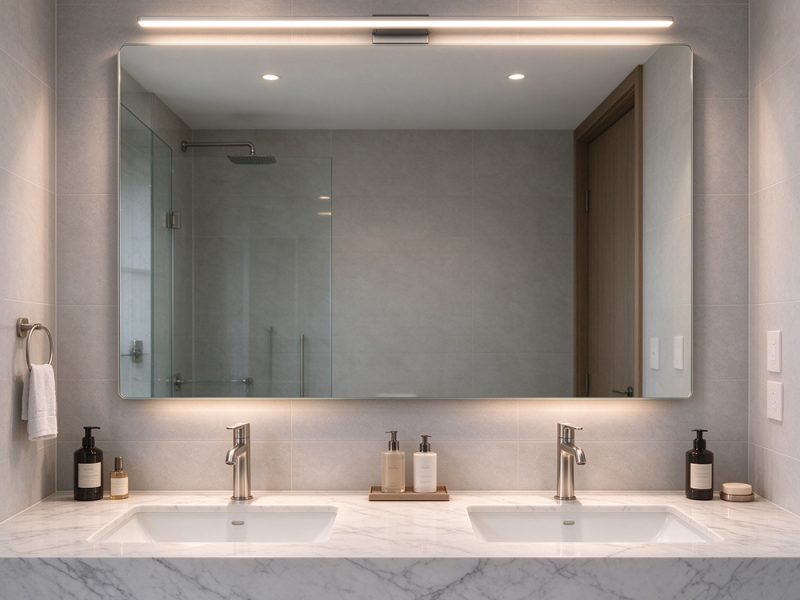
1. Above the Mirror
Installing a horizontal LED fixture above the mirror is one of the most common solutions. It provides a clean appearance and works well in bathrooms with limited wall space.
However, the fixture should distribute light evenly rather than creating strong shadows around the eyes and chin.
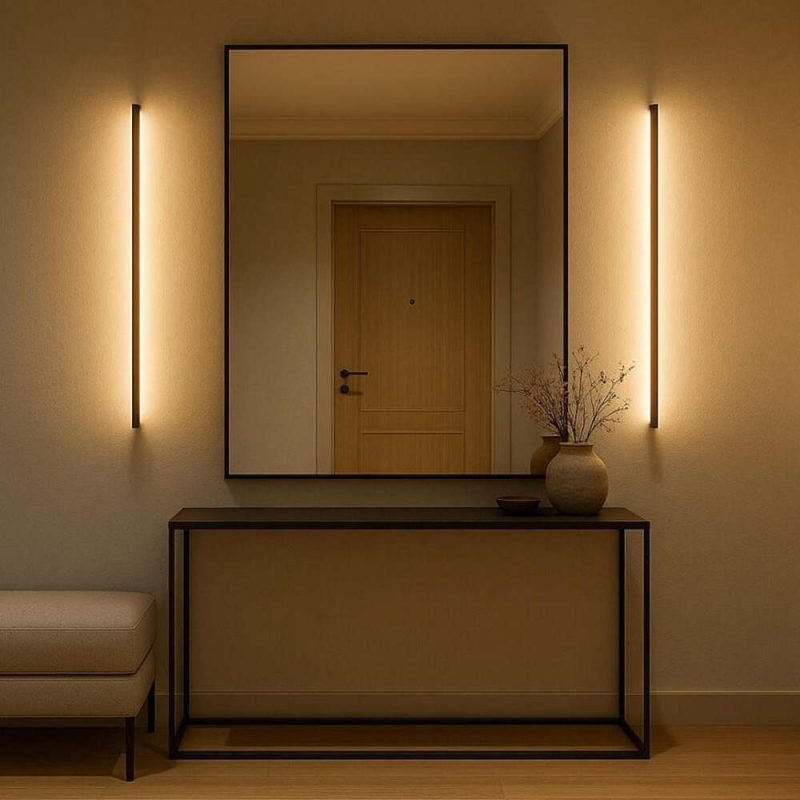
2. On Both Sides of the Mirror
Vertical LED vanity lights installed on both sides of the mirror can provide more balanced facial illumination.
This arrangement is especially useful for makeup application and shaving because light comes from both sides rather than only from above.
3. Integrated LED Mirror Lighting
An LED bathroom mirror combines the mirror and lighting into one fixture. It creates a streamlined appearance and can reduce the need for separate wall-mounted vanity lights.
Some models also include dimming, anti-fog functions, and touch controls.
Are All LED Lights Suitable for Bathrooms?
No. Although LED technology is suitable for bathroom lighting, not every LED fixture is designed to withstand moisture.
Bathrooms experience humidity, condensation, and occasional water splashes. Therefore, it is important to check the fixture’s IP rating before installation.
Common ratings include:
- IP20:Generally intended for dry indoor locations, not exposed bathroom areas.
- IP44:Provides protection against splashing water and is commonly considered for suitable bathroom zones.
- IP65:Provides protection against water jets and dust, making it suitable for more demanding wet or splash-prone environments when correctly installed.
The required protection depends on the installation location and local electrical regulations. Bathroom electrical zones have specific requirements, so an appropriate IP rating alone does not guarantee that a fixture can be installed anywhere.
Always check the manufacturer’s installation instructions and consult a qualified electrician when necessary.
What Should You Consider Before Buying LED Vanity Lights?
Before purchasing, consider these five factors:
- Brightness:Choose sufficient lumen output for the mirror size and grooming activities.
- Color temperature:Neutral white around 3500K–4000K is a versatile starting point.
- CRI:Look for CRI 90 or above if accurate color rendering is important.
- Moisture protection:Select a fixture with an appropriate IP rating for its installation location.
- Dimming and controls:Adjustable brightness and color temperature provide greater flexibility.
It is also worth checking the fixture’s dimensions, mounting method, power requirements, and compatibility with existing wall switches or dimmers.
Final Thoughts
So, are LED lights good for bathroom vanity? Absolutely. They combine energy efficiency, long service life, flexible designs, and adjustable lighting performance, making them an excellent option for modern bathrooms.
The key is choosing the right product for your needs. Pay attention to color temperature, brightness, CRI, and moisture protection rather than focusing on appearance alone.
With a properly selected and installed LED light for bathroom vanity areas, you can create a space that is both visually attractive and practical for everyday grooming.