
When choosing under cabinet lighting, one of the most common questions is surprisingly simple:
Should I use puck lights or strip lights?
Both are popular LED lighting solutions, and both can make a kitchen, workspace, or cabinet look dramatically better after dark. But they create very different lighting effects.
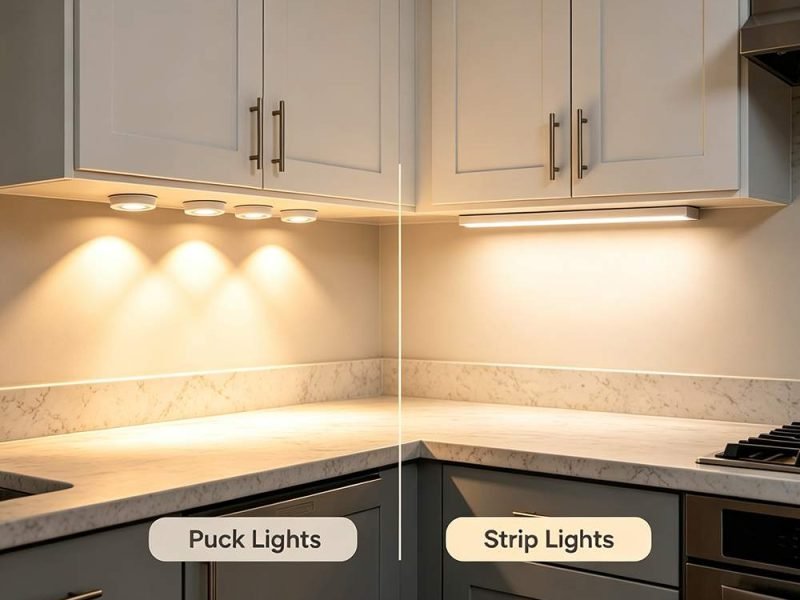
Puck lights produce concentrated pools of light. They can create attractive patterns on a backsplash and work particularly well when you want to highlight specific areas or objects.
Strip lights, on the other hand, create a continuous line of illumination. They are usually better when the goal is to evenly illuminate an entire countertop or work surface.
So, which one is better?
The honest answer is: it depends on what you want your under cabinet lighting to accomplish.
If you need practical task lighting for cooking and food preparation, LED strip lights will usually be the better choice. If you want decorative accents, focused illumination, or a more traditional lighting effect, puck lights may be the better fit.
Let’s compare the two in detail.
Quick Video Share
Before we take a detailed look at which is better for under cabinet lighting—puck lights or strip lights—let’s first watch a comparison video shared by a YouTuber. It will give us a more visual and intuitive understanding of the differences between these two types of lights before we dive into a more detailed comparison.
Video Link: https://www.youtube.com/watch?v=tQBXakoBVuU
What Are Puck Lights?
Puck lights are small, individual LED fixtures named after their compact, round shape, which resembles a hockey puck.
Unlike a continuous strip, each puck is a separate light source. The fixture directs light downward onto a specific area of the countertop.
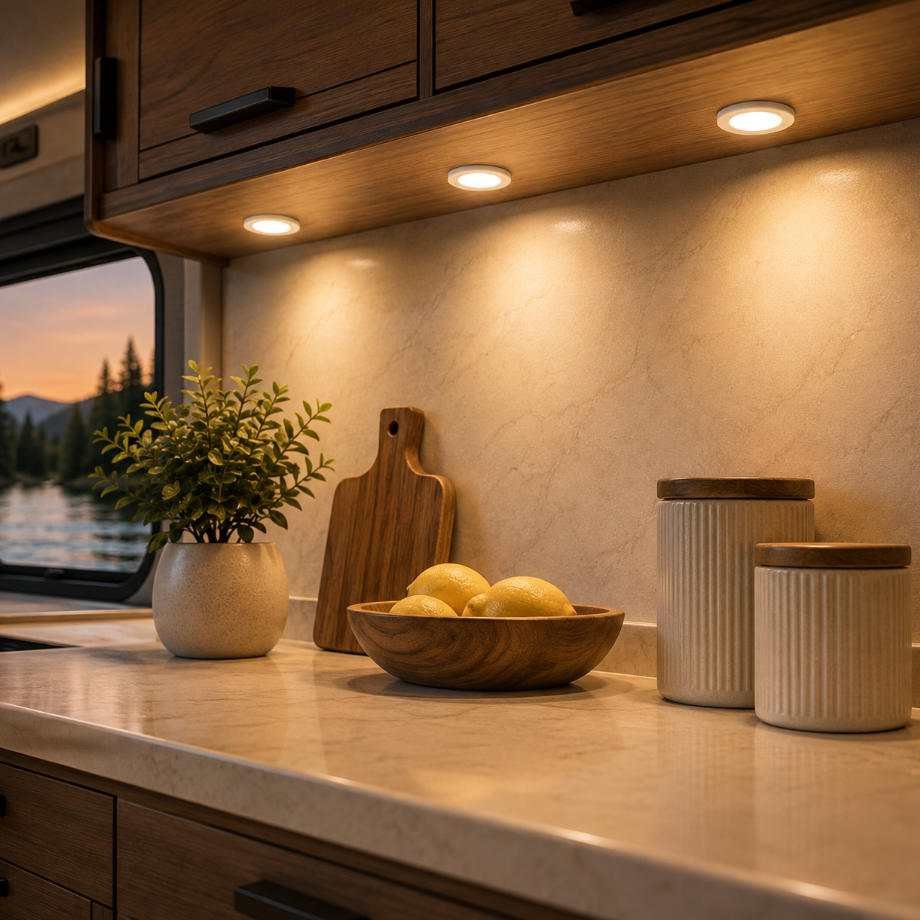
Because the light comes from individual points, puck lights create recognizable pools of illumination. When several are installed underneath a cabinet, the overlapping beams can produce alternating areas of brighter and softer light.
This can create what is sometimes called a scalloped lighting effect on the backsplash.
For some kitchens, that’s exactly what the designer wants.
Instead of producing one continuous line of light, the individual beams add visual depth and can emphasize textured tile, stone, or decorative surfaces.
Puck lights are therefore not necessarily an inferior version of strip lights. They simply serve a different purpose.
They are especially useful for display cabinets, glass-front cabinets, shelves, small work zones, and areas where you want to draw attention to a particular object.
What Are LED Strip Lights?
LED strip lights, sometimes called LED tape lights, use a flexible circuit board with multiple LED emitters arranged along its length.
Instead of creating separate pools of light, the LEDs form a continuous linear light source.
This makes strip lighting particularly attractive for long cabinet runs.
You can install a strip underneath the cabinet and illuminate almost the entire length of the countertop, rather than relying on several individual fixtures.
Many LED strips can also be cut at designated cutting points, making it easier to customize the length for different cabinet sizes.
For a professional-looking installation, however, simply sticking an LED strip underneath the cabinet isn’t always the best solution.
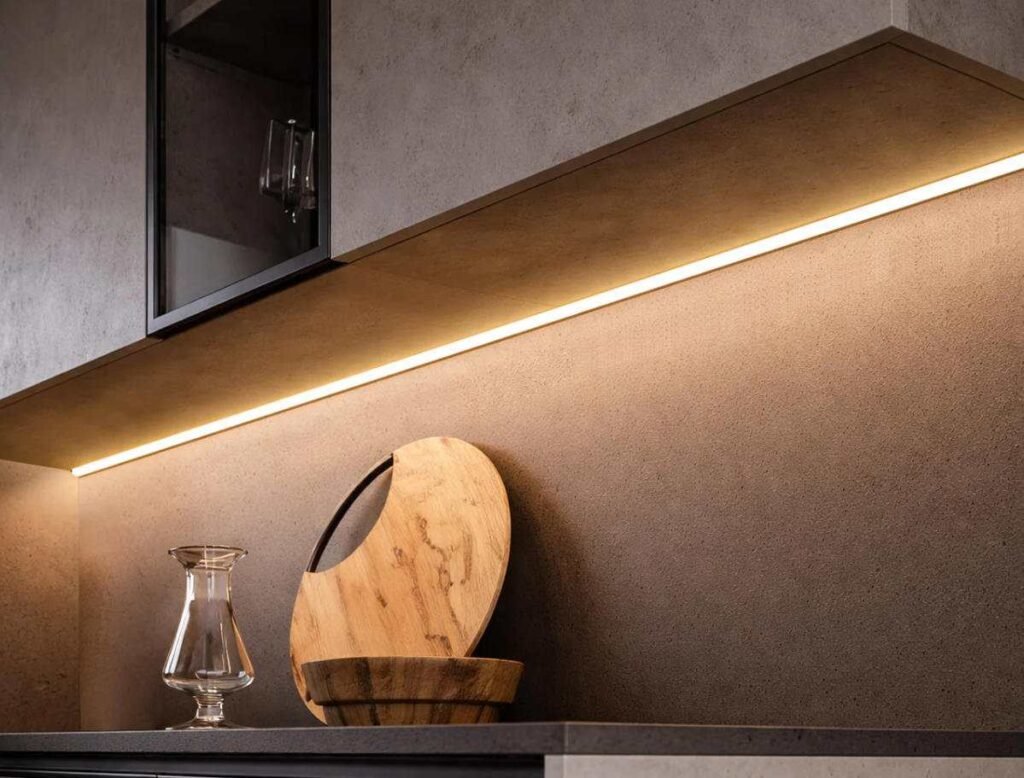
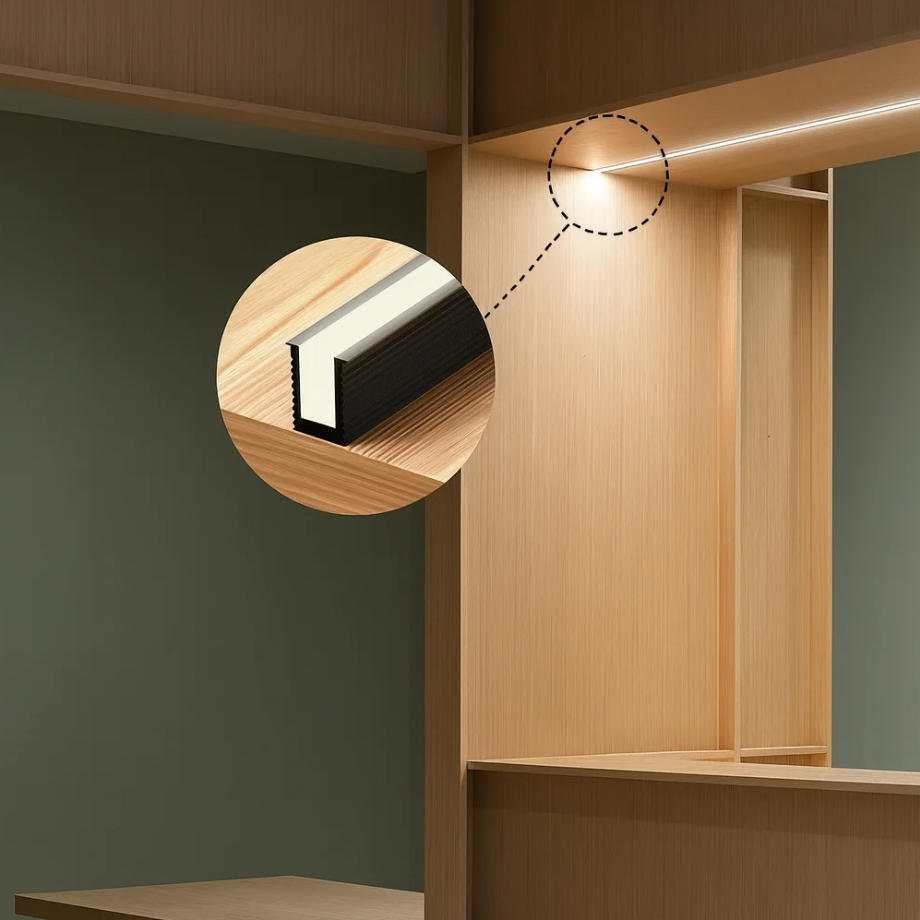
An aluminum LED profile with a diffuser can improve the result significantly. The aluminum profile helps manage heat, while the diffuser softens the light and reduces visible LED points.
That combination is particularly useful when the countertop is made from polished stone or another reflective material.
Puck Lights vs. Strip Lights: The Biggest Difference
The fundamental difference comes down to one thing:
Puck lights are point-source lighting.
Strip lights are linear lighting.
And that difference affects almost everything else.
Feature | Puck Lights | LED Strip Lights |
Light distribution | Focused pools | Continuous illumination |
Appearance | Decorative, more visible | Minimalist, often hidden |
Countertop coverage | Localized | Broad and consistent |
Shadows | More likely | Generally fewer |
Backsplash effect | Scalloped/patterned | Smooth wash |
Best use | Accent & display | Task lighting |
Long cabinet runs | Less uniform | Excellent |
Installation | Multiple fixtures and wiring | Continuous run |
Custom length | Limited by fixture spacing | Highly flexible |
Best style | Traditional/decorative | Modern/minimalist |
This table gives you the quick answer, but the real differences become clearer when we look at how the two systems behave in an actual kitchen.
Puck Lights: Where They Work Best
Puck lights are particularly good when you don’t necessarily want every inch of the countertop illuminated.
Imagine a kitchen with a beautiful stone backsplash.
Instead of flooding the entire wall with light, you could place several puck lights underneath the cabinets. Each fixture creates a small pool of illumination, producing highlights and shadows across the backsplash.
The result can feel warm and decorative.
Puck lights can also be useful for:
Glass-front cabinets
If you have glass-front cabinets displaying wine glasses, dishes, or decorative objects, a puck light can highlight the contents much more effectively than a continuous strip.
Coffee stations
A small coffee station doesn’t necessarily need an entire strip of light. One or two puck fixtures can provide focused illumination where you actually prepare your coffee.
Open shelving
Puck lights can highlight individual objects on shelves rather than illuminating the entire wall.
Small or irregular spaces
If the cabinet layout contains corners, short sections, or unusual shapes, individual fixtures may sometimes be easier to position.
In other words, puck lights are excellent when the goal is “look at this” rather than “let me see everything.“
The Main Disadvantage of Puck Lights: Uneven Illumination
The same characteristic that makes puck lights attractive can also become their biggest weakness.
Because each puck produces a concentrated beam, the area directly underneath the fixture can be much brighter than the space between two fixtures.
If the spacing is too large, dark gaps can appear.
And there’s another problem.
Imagine you’re chopping vegetables underneath a cabinet. If the puck light is behind your hands, your body can block the light and create a shadow exactly where you need to see.
That’s not ideal for task lighting.
The issue becomes particularly noticeable when the countertop is large or when several people use the kitchen simultaneously.
Some lighting guides recommend relatively close spacing for puck lights when they are being used as task lighting, but even careful spacing does not completely change their point-source nature.
This is one of the biggest reasons continuous LED strip lighting has become so popular.
LED Strip Lights: The Advantage of Continuous Light
Now imagine the same kitchen with an LED strip installed across the entire cabinet run.
Instead of several bright spots, you get one continuous line of illumination.
The countertop receives light across a much larger area.
That means fewer dark gaps, fewer abrupt changes between bright and dim areas, and generally fewer shadows caused by your hands or cooking tools.
For food preparation, this can be a significant advantage.
You don’t necessarily need dramatically higher brightness.
You need better distribution.
That’s an important distinction.
A 1,000-lumen light concentrated into several small pools isn’t necessarily going to feel better than a lower-output system that distributes its light evenly across the entire work surface.
This is why strip lighting is generally the stronger choice for primary countertop task lighting.
Strip Lights Can Also Look More Modern
There is another reason homeowners and designers increasingly choose LED strips.
They can almost disappear.
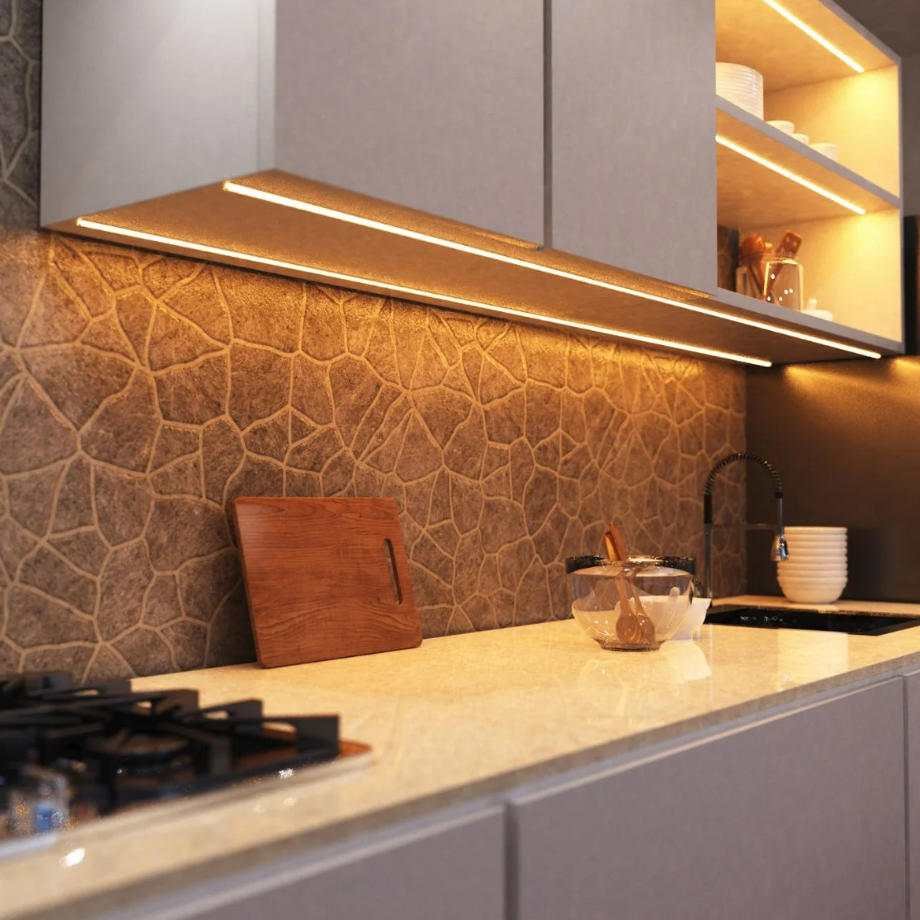
A high-quality strip installed inside an aluminum channel underneath the cabinet can create a clean, integrated appearance. When viewed from normal standing height, the light source may be barely visible.
The result is:
You see the light, not the fixture.
This works particularly well with contemporary and minimalist kitchen designs.
Puck lights can certainly be made discreet too, especially recessed models, but recessed installation requires cutting openings into the cabinet. Surface-mounted pucks may remain more visible.
So if your design goal is a very clean, architectural appearance, a diffused LED strip inside an aluminum profile has a strong advantage.
What About Glare and Reflections?
Here’s something many people don’t think about until the lights are installed:
Your countertop can reflect the lights back at you.
Polished granite, quartz, marble, stainless steel, and other glossy surfaces can behave almost like mirrors.
A puck light can create obvious bright spots on these surfaces because each fixture is a concentrated source.
LED strips can also create reflections, especially if you use a low-density strip with exposed LED points.
This is why the combination of:
high-density LED strip + aluminum profile + frosted diffuser
is often a much better solution.
The diffuser blends the individual LED points into a more continuous source, reducing the “dot” effect and helping create a softer reflection.
If you have a glossy countertop, don’t simply ask, “How bright is this light?”
Also ask:
“What will this light look like when it reflects off my countertop?”
That question can save you from an unpleasant surprise.
Which Is Easier to Install?
This one is slightly more complicated than it first appears.
You might assume puck lights are easier because you’re simply installing several small fixtures.
For battery-powered puck lights, that’s often true.
Stick the fixture underneath the cabinet, turn it on, and you’re done.
But wired puck lighting is a different story.
Each puck needs to connect to the power system, which means you may have multiple wires to route and hide.
Strip lighting generally uses a continuous run, although corners, cabinet breaks, power injection, drivers, and connections still need to be planned properly.
A professional installation therefore isn’t necessarily “puck = easy, strip = difficult.”
It depends on the system.
For a permanent kitchen installation, planning the power supply and wiring before the cabinets are finalized can make either system considerably cleaner.
Do LED Strip Lights Need an Aluminum Profile?
Technically, an LED strip can operate without an aluminum profile.
But if you’re looking for a high-quality, long-lasting installation, an aluminum profile is strongly recommended.
It provides two important benefits.
First: Heat management
LEDs generate heat.
An aluminum profile acts as a heat sink, helping transfer heat away from the LED strip.
This is important because excessive heat can accelerate LED degradation and shorten the useful life of the strip.
Second: Better light diffusion
Add a frosted diffuser and the profile becomes more than a heat sink.
It also helps blend individual LED points into a smoother line of light.
So for professional under cabinet lighting, an aluminum LED channel isn’t simply a decorative accessory. It can be part of the lighting system’s optical and thermal design.
Puck Lights vs. Strip Lights for Different Applications
Still unsure?
Let’s make the decision easier.
For kitchen countertops: Choose strip lights.
– If you’re chopping vegetables, cooking dinner, or preparing food, continuous illumination is usually more useful than concentrated pools of light.
For display cabinets: Choose puck lights.
– Their focused beams can highlight specific objects and create visual depth.
For modern minimalist kitchens: Choose strip lights.
– Especially when installed inside an aluminum channel with a diffuser.
For traditional kitchens: Either can work.
– Puck lights can create a warmer, more decorative scalloped effect, while strips provide cleaner task illumination.
For highly reflective countertops: Prefer diffused strip lights.
– A good diffuser can help reduce visible hotspots and harsh reflections.
For rental properties: Puck lights may be more convenient.
– Battery-powered versions can be installed without permanent electrical work.
For a coffee bar or small station: Puck lights can be a great choice.
– You may not need continuous illumination across the entire cabinet.
Can You Use Puck Lights and Strip Lights Together?
Absolutely.
And this may actually be the best solution for some kitchens.
There’s no rule saying your entire home has to choose one technology.
For example, you could use:
LED strip lighting under the main kitchen cabinets for continuous task illumination.
Then add:
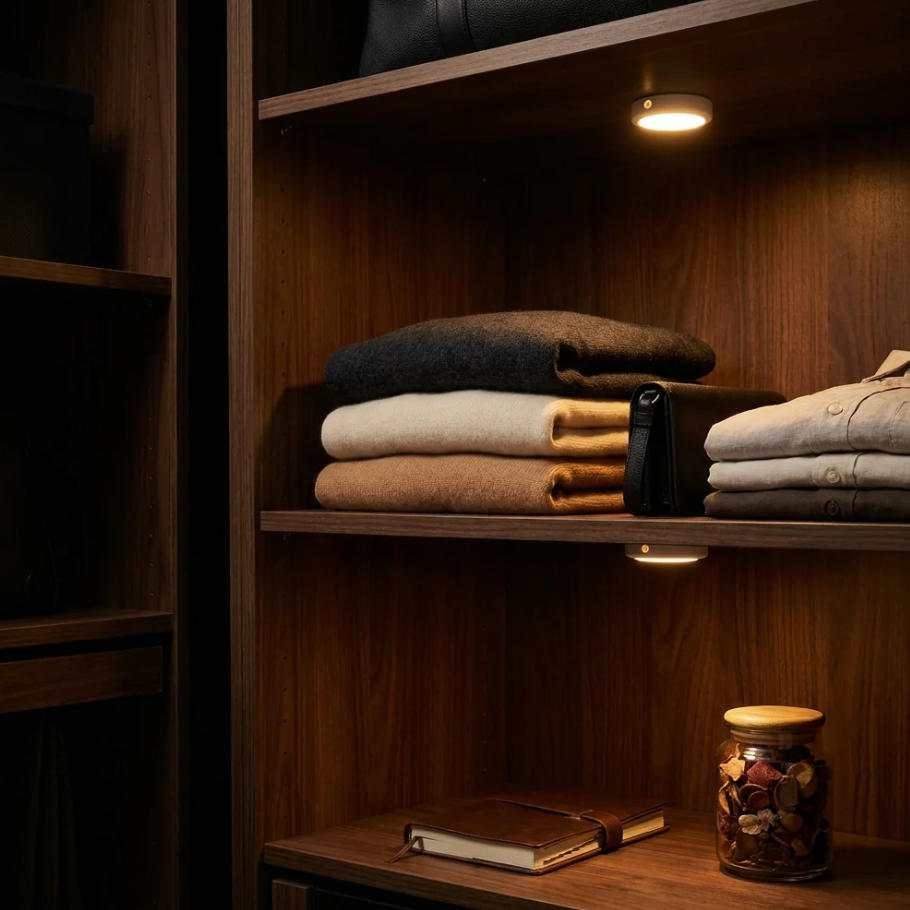
Puck lights inside glass display cabinets to highlight decorative objects.
You could even use puck lights around a coffee station or bar area while keeping strips over the primary food-preparation zones.
This creates layers of light rather than forcing one fixture type to do everything.
The combination of continuous task lighting and focused accent lighting is also consistent with how professional lighting designers approach different cabinet zones.
So, Which One Is Better?
If you want the short version:
– Puck lights are better for accent lighting.
– Strip lights are better for task lighting.
If your main goal is to illuminate a kitchen countertop evenly, reduce shadows, and create a clean modern appearance, LED strip lights are usually the better choice for under cabinet lighting.
If your goal is to highlight specific objects, create pools of light, add decorative patterns to a backsplash, or illuminate small areas, puck lights can be the more interesting option.
And if you want both functionality and decoration?
Use both.
Final Recommendation
The best under cabinet lighting isn’t necessarily the brightest one or the most expensive one.
It’s the one that puts the right amount of light in the right place.
For most primary kitchen work surfaces, a high-quality LED strip installed near the front portion of the cabinet underside, ideally inside an aluminum profile with a diffuser, provides the most consistent and comfortable result. This approach can reduce dark zones and help prevent the individual LED points from becoming distracting reflections.
Puck lights still have their place—and a very good one.
They’re excellent for display lighting, accent applications, smaller areas, and designs where the distinctive pools of light are part of the aesthetic.
So instead of asking “Are puck lights better than strip lights?”, ask a more useful question:
“Do I want my under cabinet lighting to highlight something, or do I want it to help me see?”
If the answer is highlight, choose puck lights.
If the answer is see, choose strip lights.
And if the answer is both, there’s no reason you can’t have both.